Choose your language
Teaching with limited resources
Many teachers say: “I cannot do good lessons. I have no books. No photocopier. No internet. No projector. Even chalk is sometimes hard to find.”
It is true. Teaching with limited resources is hard. But here is something we often forget: a classroom is never empty. Your students are there. Their lives, their stories, their questions. Outside the window: trees, streets, houses, markets, animals. In your community: people doing many different jobs. On the ground: paper, plastic, leaves, stones.
These are all resources.
In this lesson, we will think about a different way of seeing “resources” — and how to use what is around you.
Q2: Which of these problems do you face when resources are limited? (Tick all that apply)
- These problems are real and very common — you are not alone
- The biggest barrier is often not the lack of materials, but the way we think about “resources”. We have been trained to believe a good lesson needs printed materials
- Some of the world’s most powerful teaching happens with no books at all — just a teacher, students, and the world around them
- Lessons without paper materials can be more active, more local, and more memorable for students
- This lesson is not about pretending you have what you do not have. It is about seeing what you already have
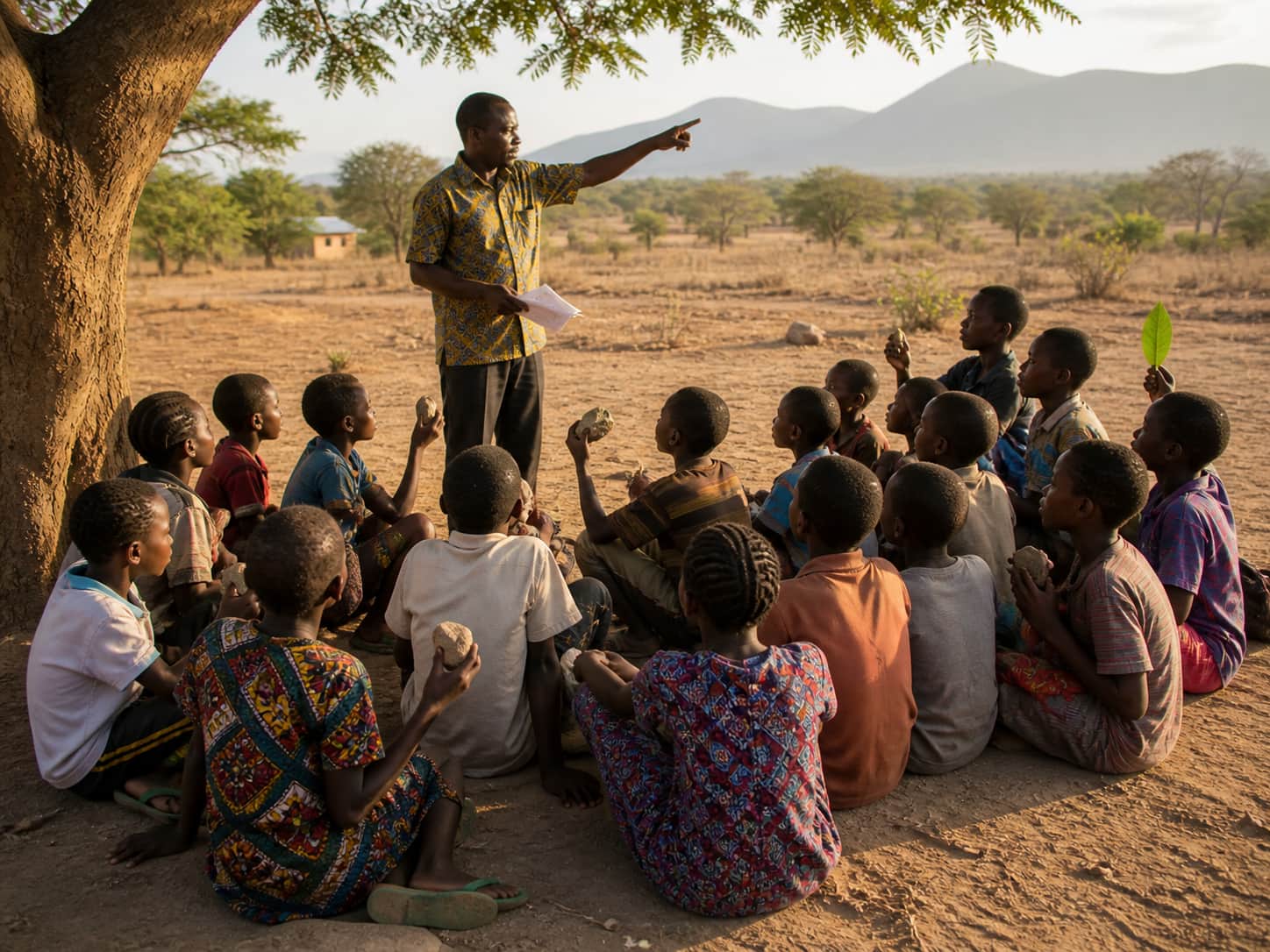
Most teachers think a “resource” means a book, a worksheet, or a poster. Something printed.
But this is only one type of resource. There are many others — and they are everywhere. A real teaching resource is anything that helps students learn. A stone can be a resource. A neighbour can be a resource. A walk to the market can be a resource. A student’s story can be a resource.
Below are five types of resources you already have, even when the cupboard is empty.
Most teachers naturally use one or two and forget the others. Notice your pattern.
- Most teachers use Resource 1 (their students) without realising it — eliciting answers, asking questions, using student examples
- The most overlooked are Resources 2 and 4 — the local environment and found objects. They feel “not serious” or “not real teaching”, but they are some of the most powerful
- You do not need to use all five every lesson. Pick one new one to try this week. That is enough
- The shift is in how you see “resources” — once you start noticing what is around you, ideas appear everywhere
Don’t panic — this is the situation many teachers face. Use what is around you. Your students. Your community. The world outside the window.
Some ideas for teaching the past with no materials:
- Ask students: “What did you do yesterday?” They share with a partner, then with the class. Free, active, and immediate practice
- Tell a short personal story: “Last weekend I went to…”. Students listen, then tell their own
- Walk outside. Point to changes: “That tree was small last year. The rain was heavy two weeks ago”
- For homework: ask one parent or grandparent “What was different when you were young?”. Bring back two answers
- Game: “Two truths and one lie about yesterday.” Class guesses the lie
None of these need anything except you and the students. And the practice is more memorable than any worksheet.
Don’t write “use found objects”. Write “collect 30 bottle caps and use them for group sorting activities about animals”.
| Strategy | Your specific idea |
|---|---|
| Use students’ own lives and stories | |
| Use the area outside the school | |
| Bring the community in | |
| Use found / waste objects | |
| Ask students to bring something in |
| Strategy | One concrete example |
|---|---|
| Use students’ own lives and stories | Before a lesson on family, ask each student to think of one person at home and three words to describe them. Pairs share, then class shares. Real, personal, free. |
| Use the area outside the school | Take students outside for ten minutes. Ask them to find five things they can describe. Back inside, they write or say one sentence about each. Walking + observing + language. |
| Bring the community in | Ask students to interview a parent or older neighbour. Just three questions. Bring the answers next lesson. Class compares answers. Reading, writing, speaking — all from one task. |
| Use found / waste objects | Collect 30 bottle caps. Write a number on each. Students work in groups, pull caps, and make sentences using that many words. Cheap, replayable, fun. |
| Ask students to bring something in | “Tomorrow, bring one small object that matters to you. Be ready to say three things about it.” Whole lesson built from student objects. They lead, you listen. |
Q6. Watch the video below. Think about which change is easiest for you to try first.
Host: We have just looked at five types of resources you already have, even when there are no books or photocopies. Now listen to three teachers. They share their problems first, then the changes they made.
Teacher 1: For years I told myself I could not do good lessons. The textbook was old. We had no posters, no pictures, sometimes no chalk. I felt embarrassed. I thought my students were missing out.
Teacher 2: I had 55 students and one shared textbook for every four students. Every lesson I struggled. I would write everything on the board, but with no chalk it was a daily fight. I felt blocked.
Teacher 3: I used to think outside the classroom was just “break time”. The trees, the road, the people walking past — I did not see them as part of teaching. They were just there.
Teacher 1: One day I just stopped. I asked my class: “Tell me about your weekend. Three things.” The room came alive. We did past tense, we did adjectives, we did questions. No textbook. Better than any textbook. Now I start every lesson with student talk.
Teacher 2: I started using bottle caps. Just bottle caps. We used them for counting, for sorting, for vocabulary, for making patterns. The students loved it. Now I keep a bag of caps in the corner. They cost nothing and I use them every week.
Teacher 3: I take my students outside once a week now. Just for ten or fifteen minutes. We describe what we see. We compare. We tell stories about the place. Their writing has changed completely — because now they have something real to write about.
Host: When teachers stop waiting for “proper” resources and start using what is around them, lessons become richer, not poorer. The classroom is never empty.
Q7. For each strategy, choose the option that best describes where you are now.
Be specific. Which resource? What lesson? What will students do? What will they learn?
- A “resource” is anything that helps students learn — not just a printed book or worksheet
- You always have five free resources: your students, the local environment, the community, found objects, and what students bring from home
- Lessons built from these resources are often more memorable than textbook lessons — because they are real, local, and personal
- You do not need to change everything. Pick one new resource type to try this week. That is enough
- The shift starts in how you see your classroom — once you stop waiting for “proper” materials, ideas start appearing everywhere
How useful did you find this lesson? Leave a rating and a comment to help other teachers.