Choose your language
Adapting your textbook
The textbook is too long. Or too short. Or too hard. Or out of date. Or written for students in a city when yours live in a village. Or all of the above.
Most teachers feel they have to teach every page, in order, exactly as written. They feel guilty when they skip something, or change it, or add their own ideas.
But here is the truth: your job is not to teach the textbook. Your job is to teach your students how to use the language. The textbook is a tool. You are the one who knows your students — the textbook does not.
In this lesson, we will look at simple, practical ways to adapt your textbook to make it work for your real class — without throwing it away.
Q2: Which problems do you have with your textbook? (Tick all that apply)
- All of these are very common problems — teachers everywhere face them
- Textbooks are written for “average” students in an “average” setting. Your students are real, and live in a real place. Some gap is normal
- You do not need to throw away the textbook to fix these problems. Small adaptations are usually enough
- The guilt about not finishing every page is the biggest barrier. Let it go. Teaching pages is not the same as teaching language
- If others (parents, head teacher, students) expect every page covered, talk to them. Explain that some pages are useful and some are not, and you are choosing what helps students most
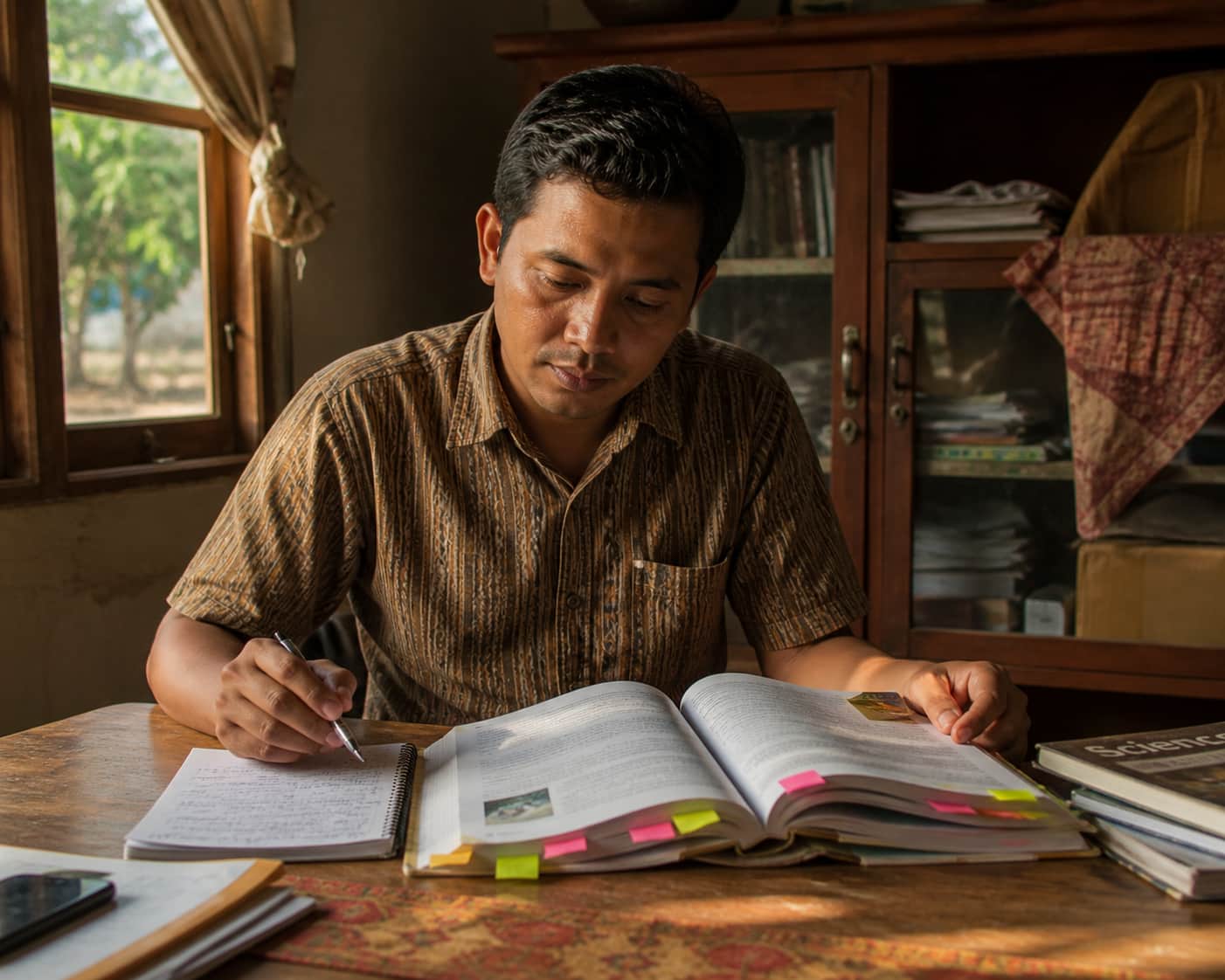
Your job is not to teach the textbook. Your job is to teach your students how to use the language.
Once you accept this, you have permission to make changes. The textbook stops being a script you must follow. It becomes a tool you use, change, skip, or supplement — whatever your students need most this week.
Below are the five most useful moves you can make. You do not need to do all of them. Pick what fits the page in front of you.
The five adaptation moves:
- Simplify — break long sentences into short ones, swap hard words for easy ones
- Contextualize — replace unfamiliar settings with ones your students know
- Personalize — ask students about their own lives using the same language
- Supplement — add a real-world text, song, story, or local example
- Change the activity type — turn a written gap-fill into a speaking task, a reading into a role-play
Be specific. Is it the language, the topic, the setting, the activity type? Naming the problem is the first step to fixing it.
- If the language is too hard — simplify. Break long sentences. Swap hard words. Pre-teach 4–5 key words before the page
- If the setting is unfamiliar (a restaurant, a snowy city, an airport) — contextualize. Use the closest local example: a market stall, a hot day, the bus station
- If the topic feels distant — personalize. Ask students about their own version of it. Their answers replace the textbook examples
- If the page is short or thin — supplement. Add a song, a local story, a short news item, a question from real life
- If it is just gap-fills and copying — change the activity. Turn it into pair speaking, a role play, a class survey, or a quick competition
You do not need a new textbook. You need permission to change the one you have.
There is often more than one option that could work. Choose the one most likely to help students learn.
Think about a real page or unit you teach. The more specific your ideas, the easier they will be to use.
| Move | Your specific idea |
|---|---|
| Simplify (break sentences, swap hard words) | |
| Contextualize (use a local example) | |
| Personalize (ask about students’ lives) | |
| Supplement (add a song, story, or real text) | |
| Change the activity type (e.g. written to spoken) |
| Move | How it can work |
|---|---|
| Simplify (break sentences, swap hard words) | Before reading a long sentence aloud, break it into two: “The waiter showed Sam to a table. He asked him what he wanted to eat.” Pre-teach 4–5 words first. Easier text = more language learned. |
| Contextualize (use a local example) | If the text is about a restaurant and your students do not have restaurants, ask: “What is like a restaurant where we live?” The market stall, the tea shop, the auntie’s kitchen. Use that as the bridge. |
| Personalize (ask about students’ lives) | After a textbook story about a family, ask: “In your family, who cooks? Who shops? Who tells stories?” The same language, but now connected to their own lives. Memorable. |
| Supplement (add a song, story, or real text) | If a unit on “weather” feels thin, bring in a local weather forecast, a song about rain, or ask students to describe yesterday’s weather. Five minutes of supplement makes the unit come alive. |
| Change the activity type (e.g. written to spoken) | Gap-fill on past tense? In pairs, students take turns reading a sentence aloud while their partner says the missing word. Same language, more fun, more practice. Most gap-fills can be adapted this way. |
Q6. Watch the video below. Think about which change is easiest for you to try first.
Host: We have just looked at the five adaptation moves. Now listen to three teachers. They share their problems first, then the changes they made.
Teacher 1: For years I felt I had to teach every page. The textbook had 180 pages. I had 120 lessons. I rushed. I skipped nothing. The students were exhausted, and many were lost by page 50. I felt I was failing them by not finishing the book.
Teacher 2: Our textbook had a story about a family going on a holiday by plane. My students had never been on a plane. Half of them had never left our district. They could not connect with the story at all. So they did not engage. I just kept teaching it page by page anyway.
Teacher 3: My textbook is full of gap-fills, copying, and short answers. The students do them in silence. They get the answers right. But they cannot speak two sentences in real conversation. The book was not preparing them for real life.
Teacher 1: I stopped trying to finish the book. Now I look at it before each unit and ask: which pages will help my students most? I might skip 4 pages. I teach 6 well. The students understand more, remember more, and we are not exhausted.
Teacher 2: I started using the textbook stories as a starting point, not the whole lesson. After the holiday story, I asked: “Where would you go if you could go anywhere? What would you take?” Suddenly they had things to say. The story became a doorway, not a destination.
Teacher 3: I changed the activity types. Same language, different format. A gap-fill on past tense became a partner game where one student read the sentence and the other guessed the missing word. Same words. Different energy. The students loved it.
Host: None of these teachers threw their textbook away. They just stopped letting it run their classroom. They kept what worked, changed what did not, and added what was missing. The textbook is your tool — not your boss.
Q7. For each adaptation move, choose the option that best describes where you are now.
Be specific. Which page? Which adaptation move? What exactly will you do?
- Your job is not to teach the textbook. Your job is to teach your students how to use the language — the textbook is just one of your tools
- You do not need to throw the textbook away. Five small moves — simplify, contextualize, personalize, supplement, change the activity — can fix most problems
- It is fine to skip pages that do not help your students. Better to teach 6 pages well than 10 pages badly
- The teacher knows the students. The textbook does not. Trust your judgement about what works for your real classroom
- If others expect every page covered, talk to them. Explain that you are choosing what helps students most. Most heads of school will support this if you can explain why
How useful did you find this lesson? Leave a rating and a comment to help other teachers.