Story
At the Doctor
Language focus: Present simple; basic verbs (go, feel, help, get); simple adjectives (sick, better)
Before you read
- Do you visit a doctor sometimes?
- What do doctors do?
- Do you feel better after seeing a doctor?
The story A1
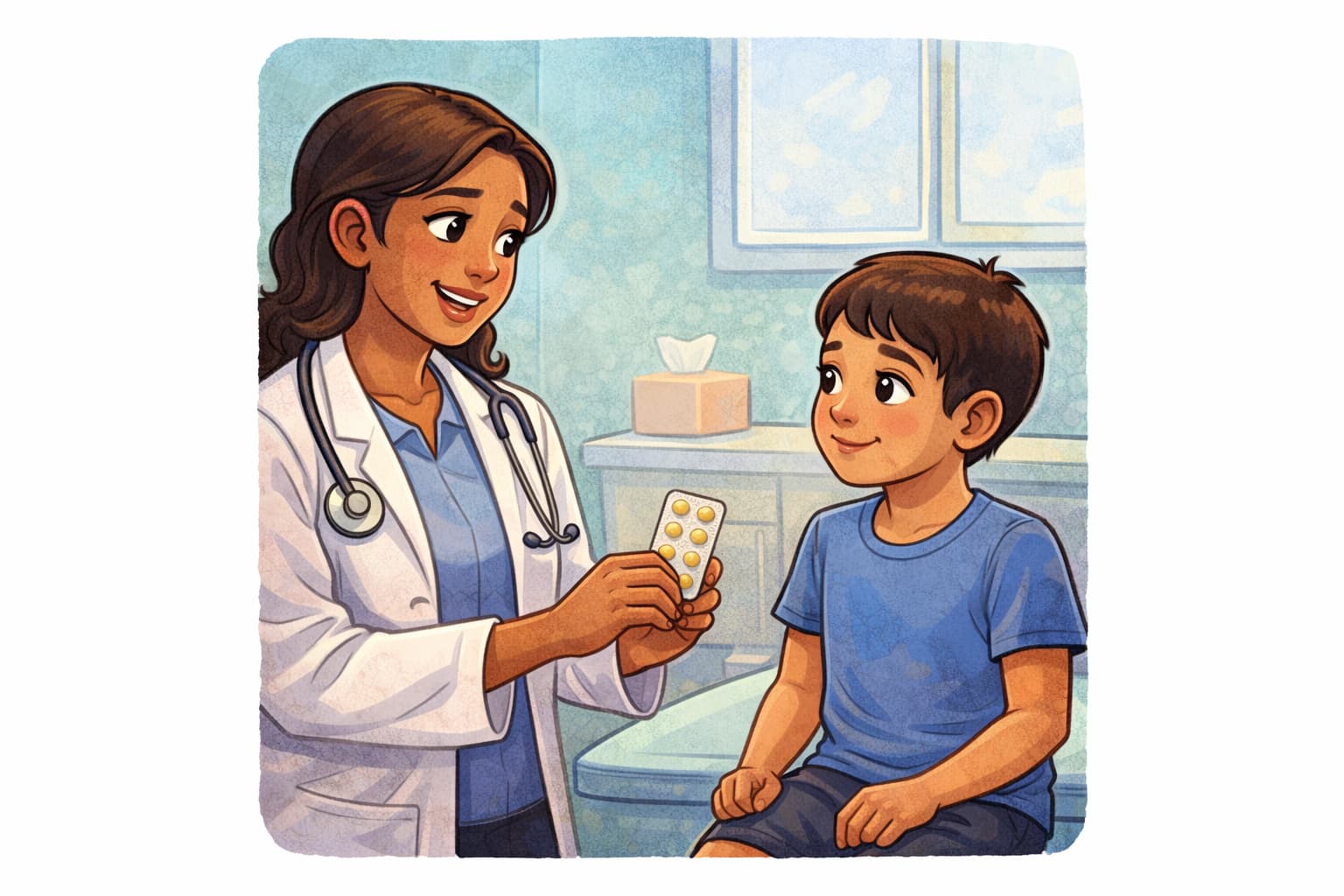
Ali goes to the doctor.
He feels sick.
The doctor helps him.
He gets medicine.
He feels better.
Key words
doctor
noun
a person trained to treat illness and injury
"Ali goes to the doctor."
sick
adjective
not well; feeling ill
"He feels sick."
medicine
noun
a substance you take to help your body recover
"He gets medicine from the doctor."
Comprehension
- 1 Where does Ali go?
- 2 How does he feel at the start?
- 3 What does the doctor give him?
Discussion
- 1 What do you do when you feel sick?
Personal reflection
- 1 Have you been to a doctor? What was it like?
Activities
- Role play doctor and patient
- Draw a doctor's room and label it
- Talk about health with a partner
Writing task
Write 3 sentences: 'When I feel sick, I ...'
Language focus: Past simple; sequence markers (so, then, after); reported instructions (he told him to...)
Before you read
- When do you visit a doctor?
- What happens at a doctor's appointment?
- Do you always take medicine when you are ill?
The story A2
Ali was feeling sick, so he went to see the doctor.
The doctor asked him some questions about how he felt.
He examined Ali carefully and then gave him some medicine.
Ali listened carefully to the instructions.
After a few days, he felt much better.
Key words
examine
verb
to look at someone's body carefully to check their health
"The doctor examined Ali carefully."
instructions
noun
information about how to do something or take something
"Ali listened carefully to the instructions."
recover
verb
to become healthy again after being ill
"He started to recover after a few days."
Comprehension
- 1 Why did Ali go to the doctor?
- 2 What did the doctor do first?
- 3 How did Ali feel after a few days?
Discussion
- 1 Why is it important to follow a doctor's instructions?
Personal reflection
- 1 What do you do to stay healthy?
Activities
- Write about an illness using past simple
- Discuss healthy habits with a partner
- Role play a doctor's appointment
Writing task
Write a short paragraph: 'The last time I was ill...' Use past simple.
Language focus: Past simple and past perfect; reported speech; health vocabulary; expressing gratitude and cause/effect
Before you read
- Why is it important to visit a doctor early when you are ill?
- What do you think makes a good doctor?
- How do you feel about taking medicine?
The story B1
Ali had not been feeling well for several days, but he had kept putting off going to the doctor. He told himself it was probably nothing serious. Eventually, when the symptoms became worse, he made an appointment.
At the clinic, the doctor listened carefully to Ali's description of how he felt. She asked about his sleep, his diet, and how long the symptoms had been going on. Then she carried out a brief examination and gave him a clear diagnosis.
She prescribed medicine and explained exactly how and when to take it. Ali appreciated that she took the time to explain rather than simply handing him a prescription. He left the clinic feeling more informed and less anxious than when he had arrived.
Within a few days, his condition improved significantly. Looking back, he realised he should have come sooner. Delaying had only made things worse — and more worrying — than necessary.
Key words
symptoms
noun
signs that suggest someone has an illness
"The symptoms became worse after a few days."
diagnosis
noun
a doctor's decision about what illness someone has
"The doctor gave him a clear diagnosis."
prescription
noun
a written order from a doctor for medicine
"She gave him a prescription for medicine."
anxious
adjective
feeling worried or nervous about something
"He felt less anxious after seeing the doctor."
Comprehension
- 1 Why had Ali delayed visiting the doctor?
- 2 What did the doctor do during the appointment?
- 3 What did Ali realise at the end?
Discussion
- 1 Why do people sometimes avoid going to the doctor even when they feel ill?
Personal reflection
- 1 Have you ever delayed getting help for a health problem? What happened?
Activities
- Discuss barriers to healthcare in different countries
- Write a summary of the story
- Debate: who is responsible for people's health — individuals or governments?
Writing task
Write a short paragraph giving advice to someone who is avoiding going to the doctor. Use should/shouldn't and give reasons.
Language focus: Mixed tenses; hedged language and professional register; abstract health vocabulary; cause and effect relationships; discursive structure
Before you read
- What responsibilities do patients have in their own healthcare?
- How does fear or embarrassment affect people's willingness to seek medical help?
- How do healthcare systems differ across the world, and what impact does that have?
The story B2
For several days, Ali had been aware that something was not right. The fatigue was manageable, the headaches intermittent, but when the two combined with a persistent loss of appetite, he could no longer attribute it convincingly to overwork or disrupted sleep. He made an appointment, though not without a degree of reluctance — he had always preferred to let things resolve themselves where possible.
The consultation was thorough and unhurried. The doctor did not simply note his symptoms and reach for a prescription pad. Instead, she asked questions that surprised him with their specificity: how long, how often, what time of day, what made it better or worse. He found himself providing details he had not thought to connect. She listened without interrupting, and when she spoke, she framed her assessment carefully — offering a likely explanation while acknowledging the limits of what she could conclude without tests.
She referred him for a blood test and prescribed a short course of medication in the interim. Before he left, she spent several minutes explaining what the test was looking for and what the various possible results would mean. Ali was struck by this. He had half-expected to leave with a prescription and little else; instead, he left with a clearer understanding of his own body and a sense that his concerns had been taken seriously.
The results, when they came, were reassuring. A minor deficiency, easily addressed. But the experience had shifted something in his thinking. He had spent years treating his own health as a background concern — something to attend to only when it became impossible to ignore. The consultation had reminded him that early attention was nearly always better than delayed action, and that a good doctor was not simply someone who treated illness, but someone who helped you understand it.
Key words
intermittent
adjective
stopping and starting at irregular intervals
"The headaches were intermittent but worrying."
attribution
noun/verb
explaining something as being caused by a particular thing
"He could no longer attribute it to overwork."
specificity
noun
the quality of being precise and exact about details
"The questions surprised him with their specificity."
deficiency
noun
a lack of something the body needs, such as a vitamin or mineral
"A minor deficiency was easily addressed."
Comprehension
- 1 What combination of symptoms finally led Ali to make an appointment?
- 2 What surprised Ali about the doctor's approach during the consultation?
- 3 What shift in thinking does Ali experience by the end?
Discussion
- 1 The story suggests that a 'good doctor' helps patients understand their illness, not just treat it. Do you agree? What else makes a good doctor?
Personal reflection
- 1 How do you decide when something is serious enough to see a doctor? What factors influence that decision?
Activities
- Debate: Should healthcare be free for everyone?
- Write the story from the doctor's perspective
- Research and present: how do healthcare systems differ between two countries?
Writing task
Write an essay (200–250 words) on the following: 'Prevention is better than cure.' Use examples from the story and your own experience to explore whether this principle is easy to put into practice.