Story
The Busy Market
Language focus: Present simple; there is/there are; adjectives (busy, happy, fresh)
Before you read
- Do you go to markets?
- What do you buy there?
- Is the market near your home?
The story A1
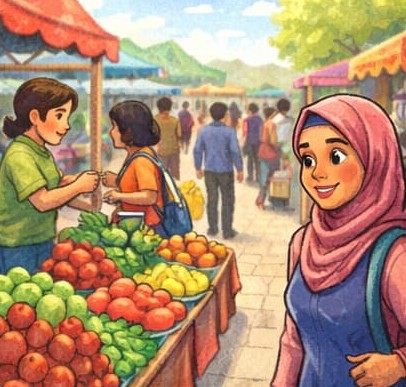
Lina goes to the market.
There are many people.
She buys fresh fruit.
She talks to a seller.
She is happy.
Key words
market
noun
a place where people buy and sell things, often outside
"Lina goes to the market every week."
fresh
adjective
recently picked or made; not stored for a long time
"She buys fresh fruit."
seller
noun
a person who sells things
"She talks to a seller."
Comprehension
- 1 Where does Lina go?
- 2 What does she buy?
- 3 Who does she talk to?
Discussion
- 1 What do you buy at a market?
Personal reflection
- 1 Describe a market you know.
Activities
- Draw a market and label it
- Role play buying fruit at a market
- Name 5 things you can buy at a market
Writing task
Write 3 sentences about a place where you buy food.
Language focus: Past simple; descriptive adjectives (colourful, noisy, lively); contrast (although, but)
Before you read
- Do you prefer markets or supermarkets?
- What do people sell at markets in your country?
- Is your local market noisy or quiet?
The story A2
Lina went to the market near her home on a Saturday morning.
There were many colourful stalls selling fruit, vegetables, and other goods.
She bought fresh tomatoes and talked to the friendly seller for a few minutes.
The market was noisy, but she enjoyed the lively atmosphere.
She left feeling happy and satisfied with her purchases.
Key words
stall
noun
a small table or stand where things are sold
"There were many colourful stalls."
atmosphere
noun
the general mood or feeling of a place
"She enjoyed the lively atmosphere."
purchases
noun
things that you have bought
"She was satisfied with her purchases."
Comprehension
- 1 When did Lina go to the market?
- 2 What did she buy?
- 3 How was the atmosphere?
Discussion
- 1 What do you prefer about markets compared to shops?
Personal reflection
- 1 Describe a market or shopping place you know well.
Activities
- Compare markets and supermarkets
- Describe a market scene to your partner
- Write a short paragraph about shopping habits in your country
Writing task
Write a short paragraph describing a market or busy place you have visited.
Language focus: Past simple and continuous; sensory description; comparing and contrasting; expressing preferences with reasons
Before you read
- Why do some people prefer markets to supermarkets?
- What do markets offer that supermarkets cannot?
- Are markets part of your local culture?
The story B1
Lina arrived at the market shortly after eight in the morning, when the best produce was still available and the stalls were at their most organised. She had been coming here every Saturday for years and knew most of the sellers by sight, if not always by name.
She moved between the stalls at her own pace, squeezing tomatoes, comparing the colour of different peppers, asking questions about where things had come from. The conversations were brief but genuine — a word about the weather, a recommendation for how to prepare something she had not bought before. It was the kind of interaction that was simply unavailable in a supermarket.
By nine o'clock the market had become considerably busier. The narrow pathways filled with people who moved in different directions, pausing to inspect things, calling across to friends. The noise increased — voices, music from a stall at the far end, the clatter of crates being moved. Lina found this energising rather than overwhelming.
She left with two bags and a small bunch of herbs she had not planned to buy, feeling the particular satisfaction of a morning well spent. A supermarket was more efficient, she knew. But efficiency was not always the point.
Key words
produce
noun
fresh fruit and vegetables grown for eating
"The best produce was available early."
genuine
adjective
real and sincere; not false or performed
"The conversations were brief but genuine."
interaction
noun
communication or contact between people
"This kind of interaction was unavailable in a supermarket."
energising
adjective
giving you energy and making you feel positive
"She found the noise energising."
Comprehension
- 1 Why did Lina arrive early?
- 2 What kind of conversations did she have at the stalls?
- 3 What does the final line mean?
Discussion
- 1 What do you think is lost when we move from markets to supermarkets?
Personal reflection
- 1 Do you prefer efficiency or experience when shopping? Give a reason.
Activities
- Compare the experience of shopping in a market vs a supermarket
- Write a sensory description of a busy place you know
- Debate: supermarkets are better for communities than markets
Writing task
Write a short paragraph: Is efficiency always the most important thing? Use an example from shopping or another part of daily life.
Language focus: Rich sensory and observational register; embedded contrast; cultural commentary; abstract vocabulary (transaction, reciprocity, community); analytical voice
Before you read
- What do markets tell us about the communities they serve?
- Is the experience of buying something important, or only the result?
- What is at risk when traditional markets disappear?
The story B2
Lina had grown up with this market. She had come here first as a child, holding her mother's hand and being allowed — if she was good — to choose one piece of fruit. Later she had come on her own, then with friends, then with a partner, then alone again. The market had remained constant through all of it, changing in small ways — a stall replaced here, a new seller there — but keeping its essential character.
She arrived at seven forty-five, earlier than most people, when the light was still low and the sellers were completing their arrangements. This was her preferred time: unhurried, still slightly cool, the smell of the produce particularly sharp before the heat of the morning dulled it. She moved without urgency, which was itself a luxury she did not take for granted.
What she valued most was not the food — a supermarket could provide equivalent quality at a lower price, and she was honest enough to admit this. What she valued was the texture of the experience: the incremental knowledge of which sellers could be trusted, the brief negotiations that were not really about money so much as about acknowledgement, the sense that she was a person making choices rather than a consumer processing a transaction.
There was a man at the herb stall who always put an extra bunch in her bag and refused to be thanked for it. There was a woman who sold pickled things from her own kitchen and who seemed to know, somehow, when Lina was tired. These were small things. But they accumulated, over years, into something that felt like belonging — which was not, she had come to understand, a feeling that supermarkets were designed to produce.
She walked home with two bags and the particular, quiet satisfaction of someone who has spent time rather than saved it.
Key words
incremental
adjective
increasing or building up gradually over time
"She had incremental knowledge of the sellers."
acknowledgement
noun
recognition that someone exists or matters
"The negotiations were about acknowledgement, not money."
accumulate
verb
to gradually build up into a larger amount
"Small things accumulate into something meaningful."
transaction
noun
an exchange, usually involving money; can also mean an impersonal interaction
"She was a person making choices, not processing a transaction."
Comprehension
- 1 How does the writer show that the market has been a constant in Lina's life?
- 2 What does Lina acknowledge about supermarkets?
- 3 What does the phrase 'spent time rather than saved it' suggest about her values?
Discussion
- 1 The story distinguishes between being 'a person making choices' and 'a consumer processing a transaction.' What does this distinction mean, and where else do you see it in modern life?
Personal reflection
- 1 Is there a place or routine in your own life that has this quality — one where the experience matters as much as the result?
Activities
- Debate: traditional markets should be protected as cultural heritage
- Write a rich sensory description of a place that matters to you
- Discuss: what is the difference between a 'transaction' and a 'relationship'?
Writing task
Write an essay (200–250 words): 'In trying to make things more efficient, we risk losing something more important.' Do you agree? Use examples from the story and your own experience.