Story
The Kind Neighbour
Language focus: Present simple; have/has; give/say/talk — basic social verbs
Before you read
- Do you have neighbours?
- Do they help you?
- Do you say hello to them?
The story A1
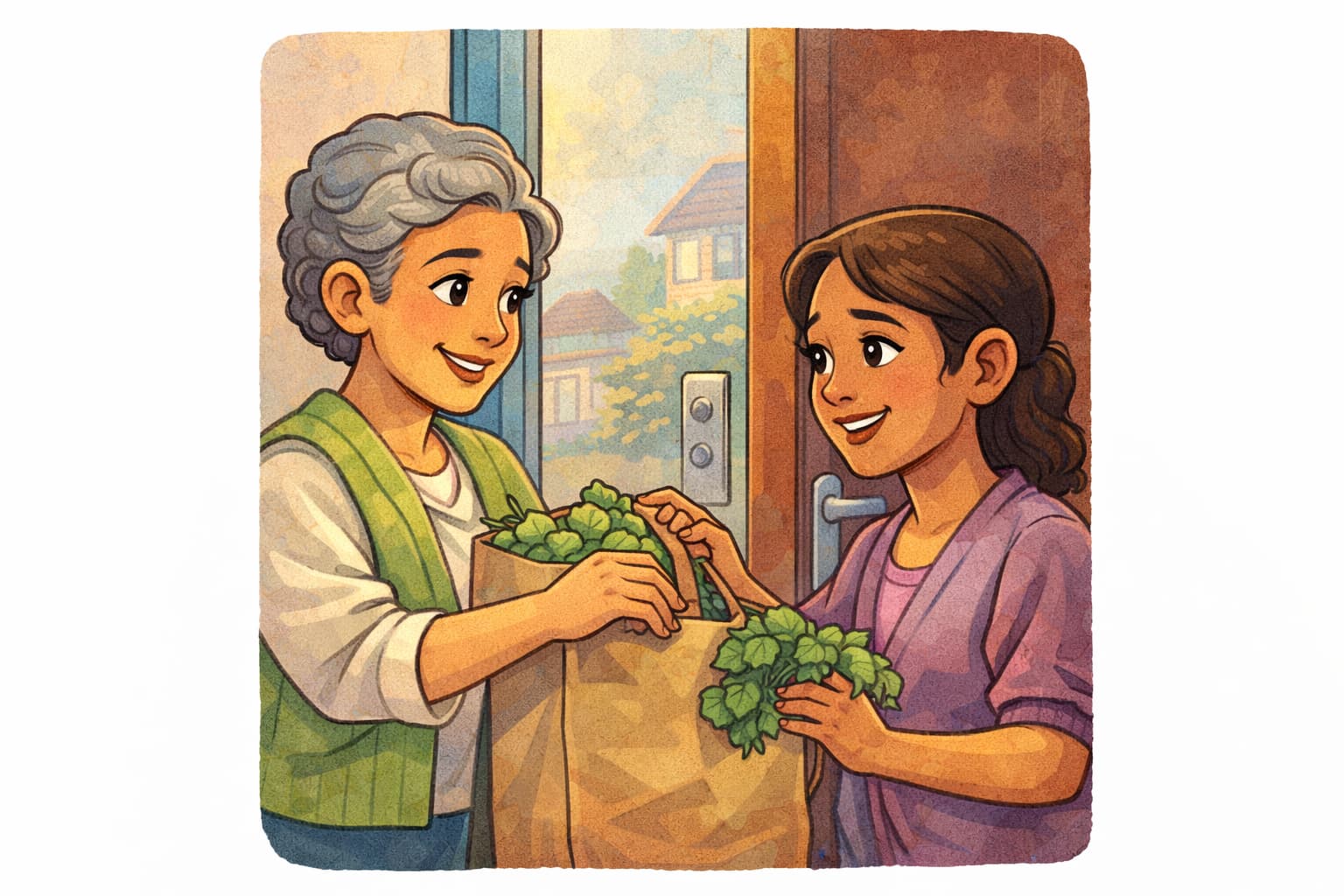
Tom has a neighbour.
She gives him food.
He says thank you.
They talk.
They smile.
Key words
neighbour
noun
a person who lives near you
"Tom has a kind neighbour."
give
verb
to pass something to someone
"She gives him food."
smile
verb
to make a happy expression with your mouth
"They smile at each other."
Comprehension
- 1 Who helps Tom?
- 2 What does she give him?
- 3 What do they do?
Discussion
- 1 Do your neighbours help you?
Personal reflection
- 1 Have you done something kind for a neighbour?
Activities
- Talk about your neighbourhood
- Act greeting a neighbour
- Draw the area where you live
Writing task
Write 3 sentences: 'My neighbour is ___. She/he ___. I feel ___ when neighbours are kind.'
Language focus: Past simple; sequence markers; expressing gratitude; feeling adjectives (grateful, friendly, welcome)
Before you read
- Why are neighbours important?
- Do you help your neighbours?
- Can neighbours become friends?
The story A2
Tom had a kind neighbour who often checked if he needed anything.
One day, she brought him some food she had cooked.
Tom thanked her and they talked at the door for a while.
They discovered they had been living next door for two years but had never really spoken.
After that, they greeted each other every day, and Tom felt less alone.
Key words
grateful
adjective
feeling thanks for something someone has done
"Tom felt genuinely grateful."
discovered
verb
found out something you did not know before
"They discovered they had been neighbours for two years."
greeted
verb
said hello to someone in a friendly way
"They greeted each other every day after that."
Comprehension
- 1 What did the neighbour bring Tom?
- 2 What did they discover?
- 3 How did Tom feel afterwards?
Discussion
- 1 Why do people sometimes not speak to their neighbours?
Personal reflection
- 1 Do you know your neighbours well?
Activities
- Write about a kind action someone did for you
- Discuss why people in cities sometimes don't know their neighbours
- Role play meeting a neighbour for the first time
Writing task
Write a short paragraph about your neighbourhood. Do people help each other? Why or why not?
Language focus: Past simple and perfect; expressing developing relationships; narrative time markers; reflecting on community
Before you read
- What is the difference between having neighbours and having a community?
- Why might people in cities feel isolated even surrounded by others?
- What small actions build connection between people?
The story B1
Tom had lived in his flat for eight months without exchanging more than a nod with the woman next door. This was not unfriendliness — it was simply the rhythm of the building, where people moved between their doors and the lift with a practised indifference that everyone seemed to share.
The knock came on a Thursday evening. She was holding a pot, explaining that she had cooked too much and thought he might like some. He took it, thanked her, and they stood in the doorway for a moment in the slightly awkward way of people who are not sure whether they are about to have a conversation or not.
They were. They talked for nearly an hour — about the building, about where they were from, about the neighbourhood. He learned her name was Fatima. She learned he had recently moved from a different city and did not yet know many people.
After that, things changed in small ways. They stopped to talk when they saw each other. She told him which shops were good. He helped her carry something heavy up the stairs one afternoon. None of it was dramatic, but the corridor felt different — less neutral, more known.
He thought about it sometimes: how close they had come to simply never speaking. How easily the eight months could have become eighteen, or three years. It was a pot of food, in the end. A very small thing, to change the quality of someone's daily life.
Key words
indifference
noun
lack of interest or concern; not caring
"A practised indifference that everyone seemed to share."
neutral
adjective
not showing any strong feelings or opinions; middle ground
"The corridor felt less neutral."
isolation
noun
the state of being alone and separate from others
"Urban life can create isolation."
corridor
noun
a long passage inside a building connecting rooms or flats
"The corridor felt more familiar now."
Comprehension
- 1 Why had Tom not spoken to his neighbour for eight months?
- 2 What changed after the conversation at the door?
- 3 What does Tom realise when he thinks back on it?
Discussion
- 1 Why might people in urban environments feel isolated even when they are surrounded by others?
Personal reflection
- 1 Have you ever made an unexpected connection with someone nearby? What happened?
Activities
- Discuss: what is the difference between proximity and community?
- Write about a time a small action made a difference to you or someone else
- Debate: modern city life makes genuine community impossible
Writing task
Write a short paragraph: What does it take to build a sense of community in a place where people do not naturally talk to each other?
Language focus: Literary register; understated emotion; social observation; abstract vocabulary (proximity, anonymity, community); irony and reflection
Before you read
- What is the relationship between physical proximity and genuine human connection?
- Why do urban environments sometimes produce loneliness despite population density?
- What obligations, if any, do we have to the people who live near us?
The story B2
Tom had been in the flat for nearly a year, which was long enough to know which pipes made noise at what times and which of his neighbours owned the dog that sometimes barked at two in the morning, but not long enough, apparently, to have spoken at any meaningful length to any of them. He did not think of this as a failure. It was simply how things were.
Fatima knocked on his door on a Thursday, holding a pot she said she had cooked too much of. He took it, thanked her, and they were both on the point of returning to their respective evenings when she said something — he could not remember exactly what — that made him laugh, and then they were talking.
The conversation lasted the better part of an hour and covered territory he had not expected: their different routes to this building, what each of them thought of the neighbourhood, an argument about a film she had seen and he had not. He was aware, somewhere during it, that he had stopped thinking about the things he had been thinking about before she knocked. This seemed significant, though he was not sure how.
In the weeks that followed, small things accumulated. She brought him a food he mentioned he had never tried; he fixed something in her kitchen that required a tool he happened to own. They stopped in the corridor. They learned each other's schedules. None of it was particularly intimate, but it changed the texture of the building — made it somewhere he felt he was known, rather than merely present.
He thought about the year of silence that had preceded it. Not with regret exactly, but with a kind of interest in how easily it could have continued. The building contained, by his rough estimate, forty-two people. He knew three of them. The arithmetic of that struck him sometimes, and when it did, he was not sure whether it said something about the building, or about cities generally, or simply about the kind of effort that community turned out to require.
Key words
proximity
noun
nearness in space or time
"Proximity does not guarantee connection."
anonymity
noun
the state of being unknown to others
"Urban anonymity can be comfortable and lonely at once."
intimate
adjective
close in relationship; involving private feelings or details
"None of it was particularly intimate."
arithmetic
noun
basic calculation; here used figuratively to mean 'the numbers'
"The arithmetic of that struck him sometimes."
Comprehension
- 1 What does the opening paragraph reveal about Tom's relationship to his building?
- 2 What shifted in the conversation with Fatima that made it feel significant?
- 3 What does the final paragraph's 'arithmetic' suggest about the nature of community?
Discussion
- 1 The story implies that community requires effort. Do you agree? What kind of effort, and who should make it?
Personal reflection
- 1 How many of your neighbours do you know? Does the number feel right to you?
Activities
- Debate: do we have a moral obligation to know our neighbours?
- Write a scene in which two strangers in the same building finally meet
- Discuss: what would make cities more connected communities?
Writing task
Write an essay (200–250 words): 'The loneliness of modern urban life is a structural problem, not a personal failure.' Do you agree? Explore the idea using examples from the story and your own experience.