Story
The Missing Bag
Language focus: Present simple and present continuous; there is/there are; basic question forms (Where? What? Who?)
Before you read
- Do you use a bus?
- What do you carry in your bag?
- Have you lost something before?
The story A1
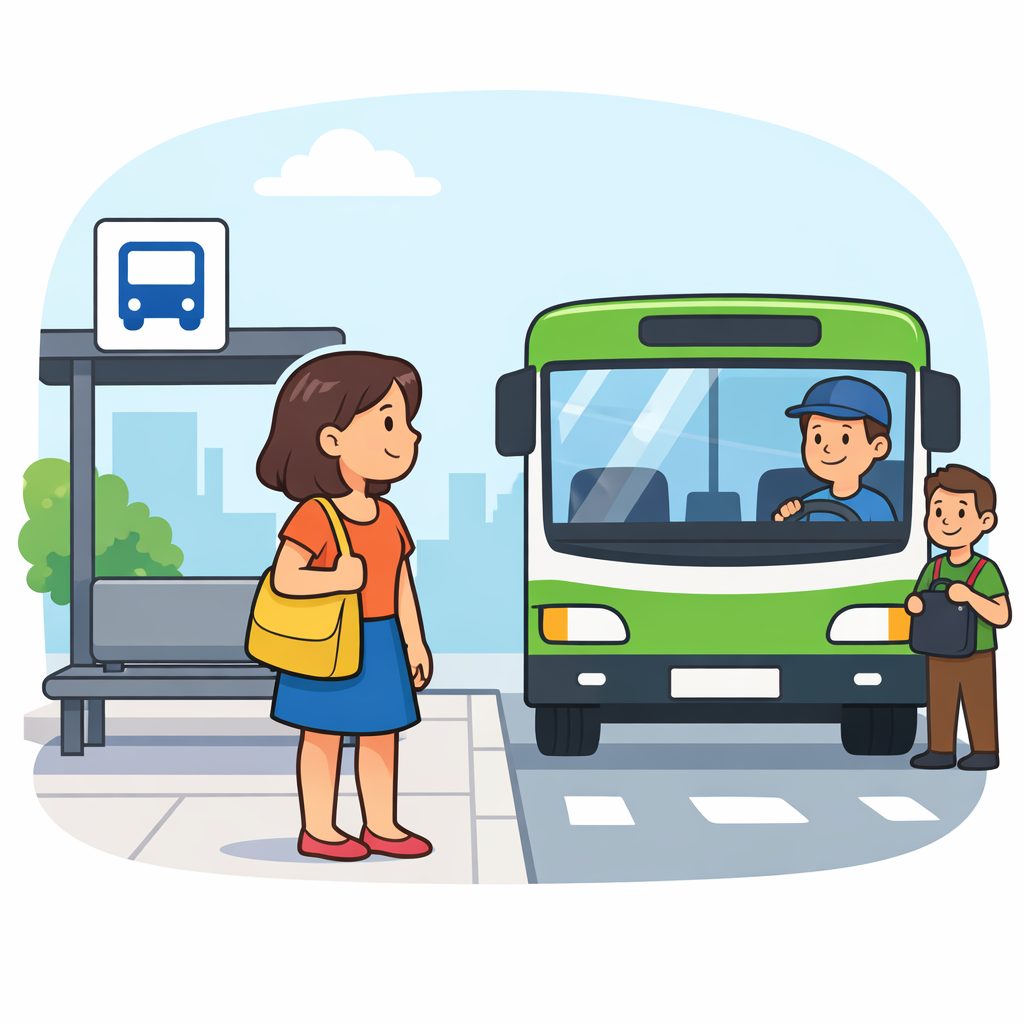
Maya is at the bus stop. She has a bag.
The bus comes and she gets on.
Later, she looks for her bag. It is not there.
A man comes to her. He has her bag.
Maya is happy. She says thank you.
Key words
bag
noun
a container you carry things in
"Maya has a bag with her."
lost
adjective
not able to be found
"Her bag is lost."
thank you
phrase
words used to show you are grateful
"She says thank you to the man."
Comprehension
- 1 Where is Maya at the start?
- 2 What does she lose?
- 3 Who helps her?
Discussion
- 1 What would you do if you found someone's bag?
Personal reflection
- 1 Have you ever lost something? What was it?
Activities
- Act the story with a partner
- Draw the bus stop scene
- Name 5 things you carry in a bag
Writing task
Write 3 sentences: 'I lost my ___. I felt ___. Then ___.'
Language focus: Past simple narrative; reported speech (he asked, she said); feeling adjectives (worried, relieved, grateful)
Before you read
- What do you do at a bus stop?
- Have you ever lost something important?
- What should you do if you find something that belongs to someone else?
The story A2
Maya was waiting at the bus stop with her bag.
When the bus arrived, she got on and found a seat.
After some time, she looked for her bag, but it was missing.
She felt worried and did not know what to do.
Then a man came towards her. He asked, 'Is this your bag?'
Maya smiled with relief and said yes. She thanked him warmly.
Key words
missing
adjective
not in the place where it should be
"Her bag was missing from her seat."
relieved
adjective
feeling better after something worrying is resolved
"She felt relieved when she saw her bag."
warmly
adverb
in a friendly and genuine way
"She thanked him warmly."
Comprehension
- 1 Why did Maya feel worried?
- 2 What did the man say to her?
- 3 How did she feel at the end?
Discussion
- 1 Why do you think the man returned the bag?
Personal reflection
- 1 Have you ever helped a stranger? What happened?
Activities
- Role play the conversation between Maya and the man
- Write 4 sentences about honesty
- Discuss: what should you do if you find a lost item?
Writing task
Write a short paragraph about a time you lost something or found something. Use past simple.
Language focus: Past simple and past perfect; adverbs of manner and degree; expressing relief and gratitude; narrative sequence
Before you read
- Why do people feel anxious when they lose something valuable?
- What would you do in this situation?
- Is it always easy to do the right thing?
The story B1
One morning, Maya arrived at the bus stop carrying her bag carefully, as she had important documents inside. When the bus came, she got on quickly and found a seat near the window.
After a few minutes, she reached into the space beside her and felt nothing. Her bag was gone. A cold feeling spread through her — she had important papers in there, and her phone. She looked under the seat and around her, but there was no sign of it.
Just as she was beginning to panic, a man who had been sitting behind her stood up and walked towards her. He was holding her bag. 'I think this is yours,' he said quietly. 'You left it at the stop.'
Maya felt an immediate rush of relief. She recognised the bag at once and thanked him sincerely. He waved away her thanks and returned to his seat. She held the bag tightly for the rest of the journey, grateful for the stranger's honesty and wondering how she could have forgotten it.
Key words
documents
noun
official papers with important information
"She had important documents in her bag."
panic
noun/verb
a sudden strong feeling of fear or anxiety
"She was beginning to panic."
sincerely
adverb
in a genuine and heartfelt way
"She thanked him sincerely."
honesty
noun
the quality of being truthful and not deceiving people
"She was grateful for the stranger's honesty."
Comprehension
- 1 Why was Maya especially worried about losing her bag?
- 2 How did the man know the bag was hers?
- 3 How did she feel for the rest of the journey?
Discussion
- 1 Do you think most people would return a lost bag? Does it depend on the situation?
Personal reflection
- 1 Describe a time when someone did something kind for you unexpectedly.
Activities
- Discuss why honesty matters in communities
- Write the man's version of events
- Debate: are people generally honest, or only when it is easy?
Writing task
Write a short summary of the story from the man's point of view. What did he see? What did he think? Why did he return the bag?
Language focus: Mixed narrative tenses; internal monologue and free indirect speech; precise vocabulary for emotion; formal reflective register
Before you read
- Why can the loss of an object feel disproportionately stressful?
- How do small acts of honesty affect the way we see other people?
- What would you do if you found something valuable that clearly belonged to someone else?
The story B2
Maya had been running slightly behind schedule that morning, which meant she was less careful than usual as she boarded the bus. She found a seat, placed her bag beside her — or thought she did — and spent the next few minutes scrolling through messages on her phone, half her attention elsewhere.
It was only when she went to reach for her bag that she realised it was not there. The sensation was immediate and unpleasant: a cold clarity that swept through her as she checked the floor, under the seat, and around the space beside her. Nothing. She tried to recall the last time she had definitely had it in her hand, but her memory was unhelpfully vague. Had she left it at the stop? Left it on the pavement while she waited?
She was on the verge of pressing the button to alert the driver when she heard a voice behind her. A man was standing in the aisle, holding out her bag with both hands. 'You left it at the bus stop,' he said, matter-of-factly, as if returning lost property were simply what one did. Which, she supposed, it was — or ought to be.
Maya thanked him far more effusively than the situation perhaps required, and he accepted it with a small nod before returning to his seat. For the rest of the journey she kept the bag firmly in her lap, but her thoughts kept returning to the man. He had gone slightly out of his way — had had to pick the bag up, carry it onto the bus, identify her among the passengers, and approach a stranger. A small thing, perhaps. But it was exactly those small, unremarked acts of honesty that held the fabric of everyday life together, and she found herself genuinely moved by it.
Key words
disproportionate
adjective
larger or more extreme than the situation seems to justify
"The stress felt disproportionate to the event."
effusively
adverb
expressing feelings in an unrestrained and enthusiastic way
"She thanked him far more effusively than necessary."
matter-of-factly
adverb
in a calm, practical way, without emotion
"He said it matter-of-factly, as if it were obvious."
unremarked
adjective
not noticed or commented on; going without recognition
"Small, unremarked acts of honesty matter."
Comprehension
- 1 What was Maya doing instead of paying attention to her bag?
- 2 What does the phrase 'cold clarity' suggest about how she felt?
- 3 How does the writer show the man's attitude towards returning the bag?
Discussion
- 1 The story says small acts of honesty 'hold the fabric of everyday life together.' What does this mean? Do you agree?
Personal reflection
- 1 Have you ever witnessed or performed an act of honesty that went unrecognised? How did it feel?
Activities
- Debate: Is honesty instinctive or a choice?
- Rewrite the story from the man's internal perspective
- Discuss: How do communities depend on small acts of trust?
Writing task
Write a reflective essay (180–220 words): 'Small acts of honesty matter more than we think.' Use evidence from the story and your own experience to support your argument.