Story
The Morning Run
Language focus: Present simple; adverbs of frequency (every morning, always); feel + adjective
Before you read
- Do you exercise?
- Do you run?
- How do you feel after exercise?
The story A1
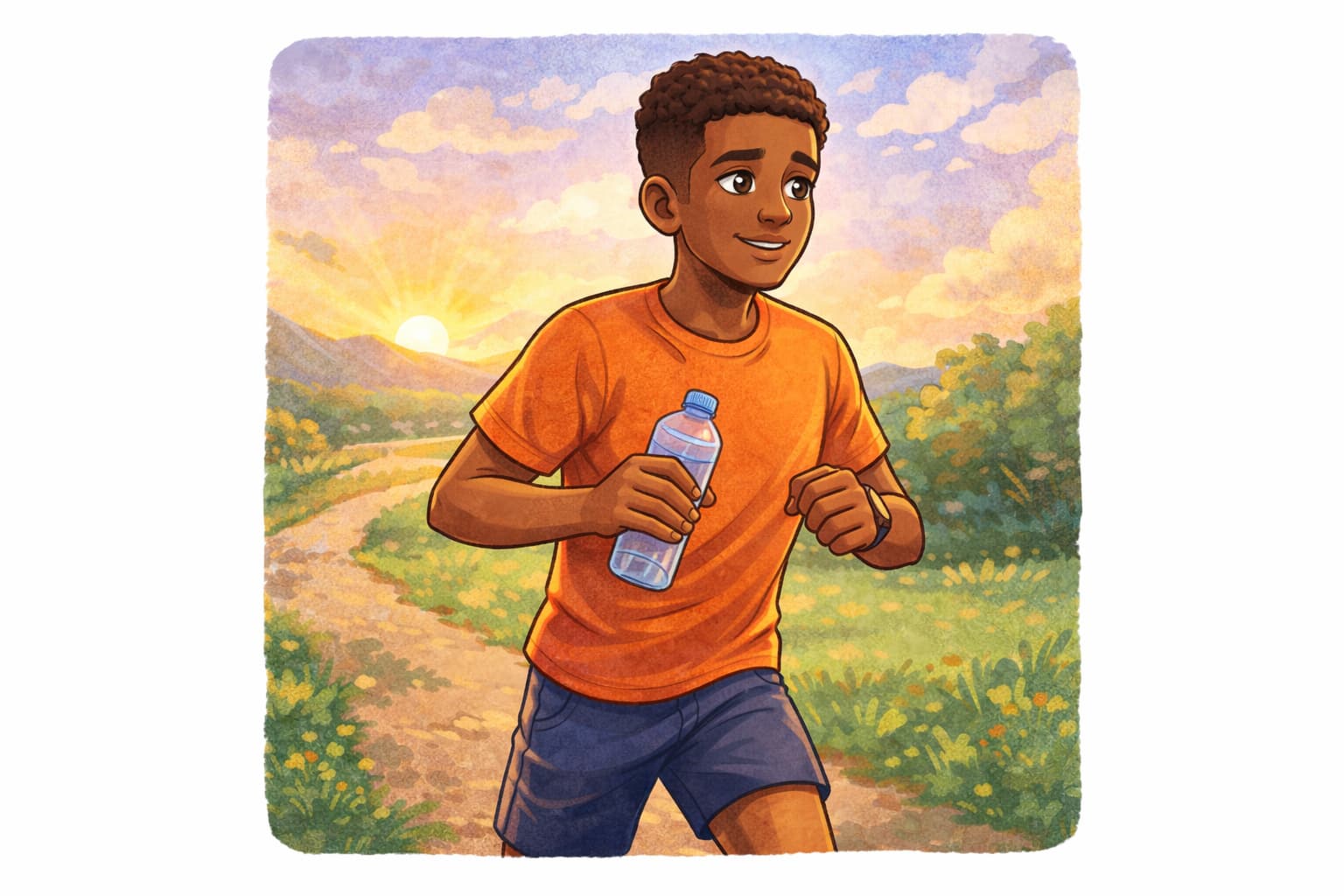
Max runs every morning.
He moves fast.
He feels strong.
He drinks water.
He smiles.
Key words
run
verb
to move quickly on foot
"Max runs every morning."
strong
adjective
having a healthy and powerful body
"He feels strong after running."
habit
noun
something you do regularly, almost without thinking
"Running is his morning habit."
Comprehension
- 1 When does Max run?
- 2 How does he feel?
- 3 What does he drink?
Discussion
- 1 Do you do exercise in the morning?
Personal reflection
- 1 What sport or exercise do you enjoy?
Activities
- Talk about exercise you do
- Act different types of sport
- Draw a healthy morning routine
Writing task
Write 3 sentences about exercise you do or want to do.
Language focus: Present simple for habits; contrast (at first... but then); expressing physical feelings
Before you read
- Why is exercise important?
- Do you have a regular exercise routine?
- How does your body feel after physical activity?
The story A2
Max goes for a run every morning before work.
At first, it was difficult to get out of bed so early.
But after a few weeks, it became part of his routine.
Now he feels strange if he misses a run.
He says it sets him up well for the rest of the day.
Key words
routine
noun
a regular set of actions you do at the same time each day
"Running became part of his routine."
strange
adjective
unusual; not normal
"He feels strange if he misses it."
sets him up
verb phrase
prepares him and puts him in a good state
"It sets him up well for the day."
Comprehension
- 1 When does Max run?
- 2 What was difficult at the beginning?
- 3 How does he feel if he misses it?
Discussion
- 1 What healthy habits do you have?
Personal reflection
- 1 Have you ever tried to build a new habit? Was it hard?
Activities
- Discuss healthy morning routines
- Write about a habit you are trying to build
- Share health tips with a partner
Writing task
Write a short paragraph about a healthy habit you have or would like to develop.
Language focus: Present perfect for ongoing habits; expressing the relationship between effort and reward; contrast between intention and action
Before you read
- Why is it hard to maintain healthy habits?
- What is the relationship between effort and reward in exercise?
- Do you think motivation or discipline is more important for habit-building?
The story B1
Max has been running every morning for three years. He will tell you, if you ask, that he finds it easy now — but easy is relative, and he remembers what it cost him to make it easy.
In the first month, getting out of bed at six felt like a form of small violence against himself. He would lie there arguing with his own alarm, listing reasons why today was an exception. The run itself was not the difficult part — it was the fifteen seconds between deciding and doing.
What changed was not motivation. Motivation, he had discovered, was unreliable — it was there when things went well and absent precisely when he most needed it. What changed was habit: he stopped deciding each morning whether to run and started treating it as simply what happened at six o'clock, the way eating breakfast happened at seven.
Three years in, the run is the part of his day he most looks forward to. Not because it is easy — his body still protests, at least for the first few minutes — but because of what comes after: a particular quality of wakefulness, a steadiness in his thinking, a sense of having done something real before the day has properly begun.
He has tried, occasionally, to explain this to friends who say they do not have the willpower. He has stopped, mostly. The thing about habits, he thinks, is that explaining them is less useful than building them.
Key words
discipline
noun
the ability to make yourself do things even when you do not want to
"Building habits requires discipline, not motivation."
unreliable
adjective
not consistent; cannot be depended on
"Motivation is unreliable."
wakefulness
noun
the state of being fully awake and alert
"A particular quality of wakefulness."
steadiness
noun
calmness and stability; not changing quickly
"A steadiness in his thinking."
Comprehension
- 1 What was the most difficult part of starting to run?
- 2 What distinction does Max make between motivation and habit?
- 3 Why does he still look forward to the run even though it is still physically hard?
Discussion
- 1 Do you agree that discipline is more useful than motivation for building habits? Why?
Personal reflection
- 1 Have you ever successfully built a new habit? What made it stick?
Activities
- Discuss: what habits help you perform at your best?
- Write a '30-day habit plan' for something you want to change
- Debate: natural talent matters more than discipline
Writing task
Write a short paragraph: What is the difference between motivation and discipline? Which do you think matters more?
Language focus: Reflective first-person register (via close third person); sustained philosophical observation; vocabulary of habit, identity, and effort; understatement
Before you read
- Is there a point at which a habit becomes part of your identity?
- What does physical discipline teach us about other kinds of self-management?
- Why do we often struggle to do things we know are good for us?
The story B2
Max could tell you, with some precision, the moment the run stopped being something he did and became something he was. It was eighteen months in, on a morning when the weather was objectively unreasonable — cold in a way that made his lungs ache — and he went anyway, not because he was particularly motivated, or because he had argued himself into it, but simply because it was six o'clock and that was what six o'clock meant.
The shift had happened gradually, the way most important shifts do — below the level of conscious decision. He had started running to improve his fitness, which was a fine reason but an insufficient one: it produced effort that depended on mood, which meant it produced inconsistent effort. What had changed was not the activity but the framing. He had stopped thinking of the run as a task he owed his future self and started thinking of it as simply part of the structure of the day, like sleeping or eating — not optional, not negotiable, not really subject to how he felt about it on any particular morning.
The benefits were real but secondary. Yes, he was fitter. Yes, his thinking was clearer on days when he had run. But these had become incidental — welcome, but not the reason. The reason, if he had to name it, was that he had discovered something about himself through the doing of it: that he was capable of deciding something and then reliably doing it, and that this knowledge had effects elsewhere that were harder to measure but possibly more significant.
He had read, at some point, that the neurological pathway for any repeated action strengthens with each repetition — that the brain, in a quite literal sense, becomes more inclined to do what it has done before. He found this reassuring, not because it made the discipline easier, but because it suggested that consistency was its own kind of investment: that each morning was building something that would make the next morning slightly more possible than the one before.
He still found it hard some days. He had stopped expecting not to. That, too, felt like progress.
Key words
framing
noun
the way something is presented or thought about
"What changed was not the activity but the framing."
incidental
adjective
happening as a minor result of something more important
"The benefits became incidental."
neurological
adjective
relating to the nerves and nervous system, including the brain
"The neurological pathway strengthens with repetition."
consistency
noun
doing something regularly, in the same way, over time
"Consistency is its own kind of investment."
Comprehension
- 1 What does Max identify as the moment the run 'stopped being something he did and became something he was'?
- 2 What change in framing does Max describe, and why was it more effective than motivation?
- 3 What does Max say the broader benefit of the habit has been, beyond fitness?
Discussion
- 1 The story suggests that habits become most powerful when they are no longer negotiable. Do you agree? What are the risks of this approach?
Personal reflection
- 1 Is there something in your own life that you have 'stopped negotiating with yourself about'? What effect has that had?
Activities
- Discuss: at what point does a habit become part of your identity?
- Write a reflective piece on the habits that define your daily life
- Debate: discipline is more important than talent in almost any field
Writing task
Write a reflective essay (200–250 words): 'The most important thing discipline teaches us is not the skill itself, but that we are capable of deciding and doing.' Do you agree? Use examples from the story and your own experience.