Story
The Birthday Cake
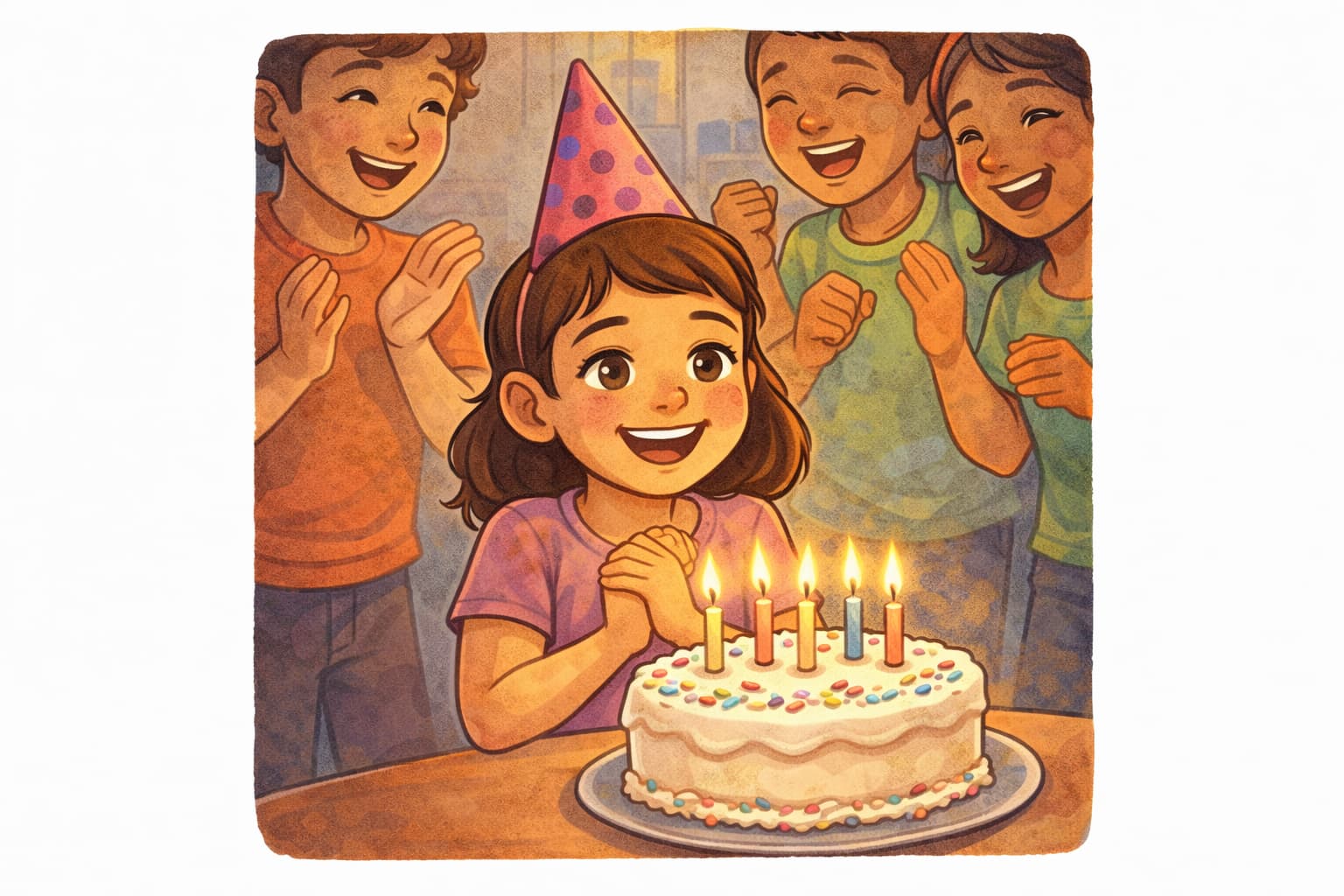
Language focus: Present simple; possessive adjectives (her, his, their); basic feeling words
Before you read
- Do you celebrate birthdays?
- Do you eat cake on your birthday?
- Who comes to your birthday?
The story A1
It is Anna's birthday.
She has a cake.
Her friends sing.
She makes a wish.
She is happy.
Key words
birthday
noun
the day of the year when you were born
"Today is Anna's birthday."
wish
noun
a hope or desire for something to happen
"She makes a wish before blowing out the candles."
celebrate
verb
to do something enjoyable for a special occasion
"They celebrate together."
Comprehension
- 1 Whose birthday is it?
- 2 What do her friends do?
- 3 How does she feel?
Discussion
- 1 How do you celebrate birthdays in your family?
Personal reflection
- 1 What is your favourite part of a birthday?
Activities
- Talk about birthdays in your country
- Draw a birthday scene
- Sing Happy Birthday in English and in your language
Writing task
Write 3 sentences: 'My birthday is in ___. I celebrate with ___. I feel ___ on my birthday.'
Language focus: Past simple; describing events in sequence; adjectives for describing atmosphere (joyful, warm, memorable)
Before you read
- How do you celebrate birthdays?
- Who do you invite?
- What do you enjoy most about parties?
The story A2
It was Anna's birthday, and she had invited her closest friends.
They arrived with gifts and were smiling when they came through the door.
Anna had prepared a large cake with candles on the table.
She made a wish, blew out the candles, and everyone clapped.
The evening was warm and joyful, and she felt truly happy.
Key words
joyful
adjective
full of happiness and good feelings
"The evening was warm and joyful."
prepared
verb
made or organised something in advance
"Anna had prepared the cake earlier."
clapped
verb
hit the palms of your hands together to make a sound
"Everyone clapped when she blew out the candles."
Comprehension
- 1 Who came to Anna's birthday?
- 2 What happened with the cake?
- 3 How did the evening feel?
Discussion
- 1 What makes a birthday feel special?
Personal reflection
- 1 Describe your best or most memorable birthday.
Activities
- Write about a memorable celebration
- Describe birthday traditions in your culture
- Compare birthday customs in two different countries
Writing task
Write a paragraph describing a celebration you remember well. What happened? How did it feel?
Language focus: Past perfect and past simple; descriptive atmosphere; expressing emotional significance; contrast between expectation and experience
Before you read
- Why do people celebrate birthdays?
- What makes a gathering feel meaningful rather than just a party?
- Do you think birthdays become more or less important as we get older?
The story B1
Anna had not expected much from her birthday this year. She was older than she used to feel, and the kind of big celebrations that had once seemed important now felt unnecessary. She had mentioned the date to a few close friends and left it at that.
When they arrived at her flat that evening, she was surprised to see how much effort they had made. There was food on the table she had not cooked, music she had not chosen, and a cake — simple and slightly imperfect — that someone had clearly made themselves. Small details, but they added up to something.
After dinner, they gathered around the table. Someone lit the candles. Anna made a wish — she kept it to herself, as she always did — and then blew them out. Her friends laughed and sang, not entirely in tune, and the flat felt warmer and louder than it had in a while.
Later, when the others had left and she was tidying up, Anna thought about what had made the evening feel so different from what she had expected. It was not the food or the cake. It was the simple fact that the people in her life had noticed the day and decided it mattered. That, she thought, was what celebration really was.
Key words
unnecessary
adjective
not needed; more than is required
"Big celebrations now felt unnecessary to her."
imperfect
adjective
not perfect; having small flaws or mistakes
"The cake was slightly imperfect but beautiful."
gathered
verb
came together in one place
"They gathered around the table after dinner."
noticed
verb
became aware of something; paid attention to it
"The people in her life had noticed the day."
Comprehension
- 1 Why had Anna not expected much from her birthday?
- 2 What surprised her about the evening?
- 3 What does Anna conclude that 'celebration really is'?
Discussion
- 1 Do you agree that being noticed and remembered is more meaningful than expensive celebrations?
Personal reflection
- 1 Think of a celebration or event that felt more meaningful than expected. What made it feel that way?
Activities
- Discuss: what makes celebrations meaningful?
- Compare birthday traditions in different cultures
- Write about a simple moment that felt important
Writing task
Write a short paragraph: What is the difference between a celebration and a gathering? What makes a moment feel genuinely special?
Language focus: Sophisticated register; nuanced emotional vocabulary; implicit theme (connection, ageing, attention); symbolic detail; contrasting perspectives
Before you read
- As people get older, how do their attitudes towards celebrations tend to change?
- What is the difference between marking an occasion and genuinely celebrating it?
- Can a birthday be both a joyful and a melancholy event? How?
The story B2
Anna had reached an age at which birthdays provoked in her a quiet ambivalence. She was glad to be alive — more genuinely glad than she had been at earlier points in her life, when health and time had seemed like things one simply had rather than things one appreciated. But celebrations had come to feel like events that happened around her rather than to her, and she had started to find the production of happiness on cue slightly exhausting.
She had mentioned the date to three people and deliberately not mentioned it to anyone else. No social media announcement, no plans. She had given herself permission to simply let the day pass, which was itself, she realised, a form of celebration — or at least a form of freedom.
What she had not accounted for was her friends. They arrived that evening without announcement, with food and wine and a cake that was clearly homemade, its icing slightly uneven, which somehow made it better. They did not perform celebration; they simply brought it with them, in the easy way of people who had known her long enough to know what she actually needed.
After they had eaten and the candles had been blown out and the conversation had shifted through half a dozen subjects — none of them her birthday, which was also a kind of gift — Anna sat for a moment in the warm noise of her own kitchen and felt something she had not expected to feel: grateful, not in a polite or performative sense, but properly so. Grateful to have been known well enough to be given exactly the right thing without being asked.
Later, alone, she thought that this might be what maturity felt like — not wisdom, exactly, but the ability to recognise something good while it was still happening.
Key words
ambivalence
noun
having mixed or contradictory feelings about something
"Birthdays provoked in her a quiet ambivalence."
performative
adjective
done in a way that is meant to be seen or noticed rather than felt
"She did not feel grateful in a performative sense."
accounted for
verb phrase
expected or considered in advance
"She had not accounted for what her friends would do."
maturity
noun
the state of being fully developed, especially emotionally
"She thought this was what maturity felt like."
Comprehension
- 1 Why did Anna decide not to announce or plan anything for her birthday?
- 2 What does the writer mean when she says the friends 'did not perform celebration'?
- 3 What does the ending suggest about how maturity changes our relationship with good things?
Discussion
- 1 The story explores a distinction between performed and genuine happiness. Where else in life do you see this distinction?
Personal reflection
- 1 Think of a moment when you received exactly what you needed without having to ask for it. What made that possible?
Activities
- Discuss: is there pressure on people to perform happiness on special occasions?
- Write the story from the perspective of one of the friends
- Debate: social media has made celebration more performative and less genuine
Writing task
Write an essay (200–250 words) exploring the following idea: 'The best gifts are the ones that show someone knows you.' Do you agree? Use examples from the story and your own experience.