Story
The Late Train
Language focus: Present simple; location expressions (at the station, on the platform); basic question forms
Before you read
- Do you travel by train?
- Do you sometimes wait for transport?
- What do you do while you wait?
The story A1
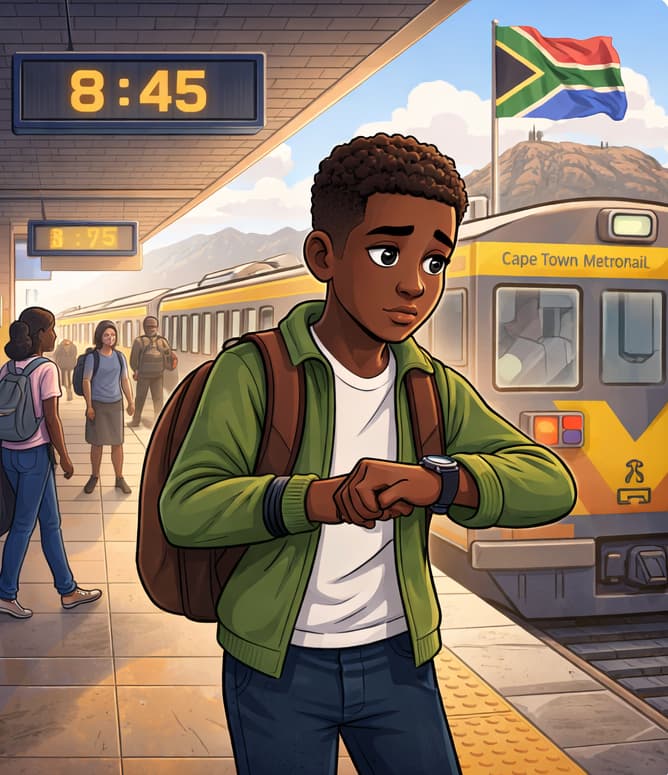
Sam is at the train station.
The train is late.
He waits and sits down.
He talks to a woman.
The train arrives. He is happy.
Key words
station
noun
a place where trains stop for passengers
"Sam is at the train station."
late
adjective
arriving after the expected time
"The train is late."
arrive
verb
to reach a place
"The train arrives at last."
Comprehension
- 1 Where is Sam?
- 2 What is the problem?
- 3 Who does he talk to?
Discussion
- 1 What do you do when you have to wait?
Personal reflection
- 1 Do you like or dislike waiting? Why?
Activities
- Act waiting at a station with a partner
- Talk about transport you use
- Draw a train station scene
Writing task
Write 3 sentences about waiting: 'I wait for ___. While I wait, I ___. I feel ___.'
Language focus: Past simple; sequence adverbs (at first, then, eventually); expressing feelings in the past
Before you read
- What do you do when transport is delayed?
- Do you ever talk to strangers while waiting?
- Is waiting always boring?
The story A2
Sam was waiting at the station when the train was announced as delayed.
He felt bored and a little frustrated sitting on the platform.
After a while, a woman sat down near him and they started to chat.
They talked about their journeys and found they had a lot in common.
When the train finally arrived, Sam almost did not want to stop talking.
He had enjoyed the delay more than he expected.
Key words
delayed
adjective
happening later than planned
"The train was announced as delayed."
platform
noun
the raised area at a station where passengers wait for trains
"He sat on the platform."
in common
phrase
shared; the same for both people
"They found they had a lot in common."
Comprehension
- 1 How did Sam feel at first?
- 2 What did he and the woman talk about?
- 3 How did his feelings change during the delay?
Discussion
- 1 Can a delay ever be a positive experience? How?
Personal reflection
- 1 Tell your partner about a time you had to wait unexpectedly.
Activities
- Role play a conversation between two strangers waiting
- Discuss: what makes waiting easier or harder?
- Write about a time something negative turned out well
Writing task
Write a short paragraph about a time you had to wait for something. How did you feel? Did your feelings change?
Language focus: Past continuous and simple; expressing emotional shifts; contrast connectives; informal conversation markers
Before you read
- How do you usually feel when a journey is disrupted?
- Do you think it is easy to start a conversation with a stranger?
- Can waiting ever be useful?
The story B1
Sam arrived at the station in good time, which made the delay announcement feel more irritating than it might have otherwise. Twenty minutes, the board said. Then, twenty minutes later: a further delay. He sat on a bench on the platform, headphones in, trying to settle into the wait.
He was not particularly successful. His mind kept returning to the meeting he might be late for, the emails he should have sent before leaving, the day already feeling slightly out of his control. He took his headphones out and sat with the noise of the station instead.
A woman about his age was sitting a few feet away, also alone, also looking at her phone. After a moment she glanced up and said, simply, 'At least the platform's sheltered.' He agreed. That was enough to begin.
They talked for the forty minutes the delay eventually lasted — about where they were going, what they did, where they were from. None of it was particularly deep, but it was easy in the way that conversations with strangers can be: no shared history, no need to be careful. When the train arrived and they found themselves in different carriages, Sam realised he felt genuinely different from how he had been sitting on that bench an hour before. Not despite the delay, he thought. Because of it.
Key words
disrupted
adjective
stopped from continuing in the normal way
"His journey was disrupted by the delay."
sheltered
adjective
protected from wind, rain, or cold
"At least the platform is sheltered."
carriages
noun
separate sections of a train where passengers sit
"They found themselves in different carriages."
shared history
noun phrase
experiences or knowledge that two people have in common from their past
"With a stranger, there is no shared history."
Comprehension
- 1 Why did Sam find it difficult to settle into the wait?
- 2 How did the conversation between Sam and the woman begin?
- 3 Why does Sam say conversations with strangers can be 'easy'?
Discussion
- 1 The story suggests that conversations with strangers feel different from those with people you know. Do you agree? What makes them different?
Personal reflection
- 1 Have you ever had a conversation with a stranger that you found surprisingly enjoyable or interesting? What made it work?
Activities
- Discuss: why can talking to strangers sometimes feel easier than talking to friends?
- Write a short story about an unexpected delay that turned into something good
- Debate: we should try to talk to strangers more often
Writing task
Write a short paragraph: Can a situation that starts as negative become positive? Describe a time this happened to you.
Language focus: Sophisticated narrative register; free indirect speech; temporal contrast; abstract vocabulary (contingency, encounter, openness); ironic observation
Before you read
- What does it mean to be 'present' in a moment rather than elsewhere mentally?
- Why might unexpected encounters with strangers feel qualitatively different from planned social interactions?
- Can disruption be a form of opportunity? Under what conditions?
The story B2
Sam had given himself exactly enough time, which is to say not quite enough time once you accounted for the delay. He stood on the platform looking at the board — now showing forty minutes, up from the twenty it had been five minutes ago — and made the calculations he made every time this happened: whether it was worth calling ahead, whether anyone would actually care, whether his irritation was proportionate. It rarely was.
He put his phone away. He had been meaning, for some weeks, to be less available — to resist the pull of the screen during idle moments rather than filling every gap with information he did not particularly need. A delayed train was not, he conceded, the ideal circumstance in which to practise this, but here he was.
The woman sat down beside him not long after — the bench was one of the few with a good view of the board. She did not immediately speak. Neither did he. But there was something in the quality of the silence — the shared inconvenience of it, perhaps — that made it feel less like the absence of conversation and more like its precondition.
She said something about the rain. He said something about the board. They talked from there for the better part of an hour, in the easy, unselfconscious way that seems available only with people you have no obligation to impress. By the end he knew her name, her general direction in life, one story about her grandmother, and her precise opinion about a particular type of person who stands in the train door when others are trying to get off. He would almost certainly never see her again.
On the train, which finally departed thirty minutes late, Sam thought about the contingency of the whole thing. He had gained nothing, strictly speaking. He had arrived later than planned and spoken to someone he would not remember to mention. And yet the afternoon felt different from how it would have felt had the train run on time — fuller, somehow, and less predictable. Which was, he thought, more or less what he had been looking for all along, without quite knowing it.
Key words
contingency
noun
a possible future event or situation; something that depends on chance
"He thought about the contingency of the whole thing."
precondition
noun
something that must exist before something else can happen
"The silence felt like the precondition for conversation."
unselfconscious
adjective
natural and relaxed, without worrying about how you appear
"They talked in an unselfconscious way."
proportionate
adjective
appropriate in size or degree relative to the situation
"His irritation was rarely proportionate."
Comprehension
- 1 What had Sam been 'meaning to practise' before the delay?
- 2 What does the writer mean by describing the silence as 'its precondition'?
- 3 What does Sam mean when he says the afternoon felt 'fuller' than it would have otherwise?
Discussion
- 1 The story explores the idea that the best experiences are often unplanned. Do you agree? What conditions make unexpected encounters possible?
Personal reflection
- 1 Can you think of a time when something that went wrong led to something unexpectedly good? What role did your attitude play?
Activities
- Discuss: does modern technology make it harder to be present in unexpected moments?
- Write the woman's version of the same encounter
- Debate: we are too focused on efficiency, and it costs us more than we realise
Writing task
Write a personal essay (200–250 words) on the following: 'The most interesting moments in life tend to be the unplanned ones.' Use the story and your own experience to explore whether this is true.