Choose your language
Using questions well
Host: Questions are the most powerful tool in your classroom. You ask hundreds every day. But here is the strange thing — most teachers have never been taught how to ask them well.
Think about your last lesson. How many of your questions had only one right answer? How many invited real thinking? Who answered them — the same loud voices, or everyone? And after you asked, how long did you wait before someone spoke?
A good question can wake a whole class up. A bad question can shut it down. The difference is smaller than you think.
Q2: Which of these things happen with questions in your lessons? (Tick all that match.)
These are some of the most common patterns in classrooms everywhere. Each one has a simple fix:
- Same students answer. Choose who answers by name. Do not let students shout out.
- Yes/no questions only. Mix in “why” and “how” questions. They make students think, not just guess.
- Not waiting. Count to ten in your head after you ask. Silence is the sound of thinking.
- Moving on too fast. When a student answers, ask one more question. “Why?” or “What if?” Go deeper.
- “Do you understand?” never works. Students will always say yes. Ask a real question that shows if they understand.
- Shouting out. Tell students you will choose the answerer. Then do it — pick by name.
Each fix is small. Together, they change everything about how your class learns.
Two big types of question
Most teacher questions are one of these two kinds. Both are useful — but you need both.
“What is the capital of Kenya?”
“Did Mary go to the market?”
“Is this a verb?”One right answer. Quick to check facts. But shallow.
“Why do you think Mary went to the market?”
“How would you describe this picture?”
“What might happen next?”Many possible answers. Slower. Deeper thinking.
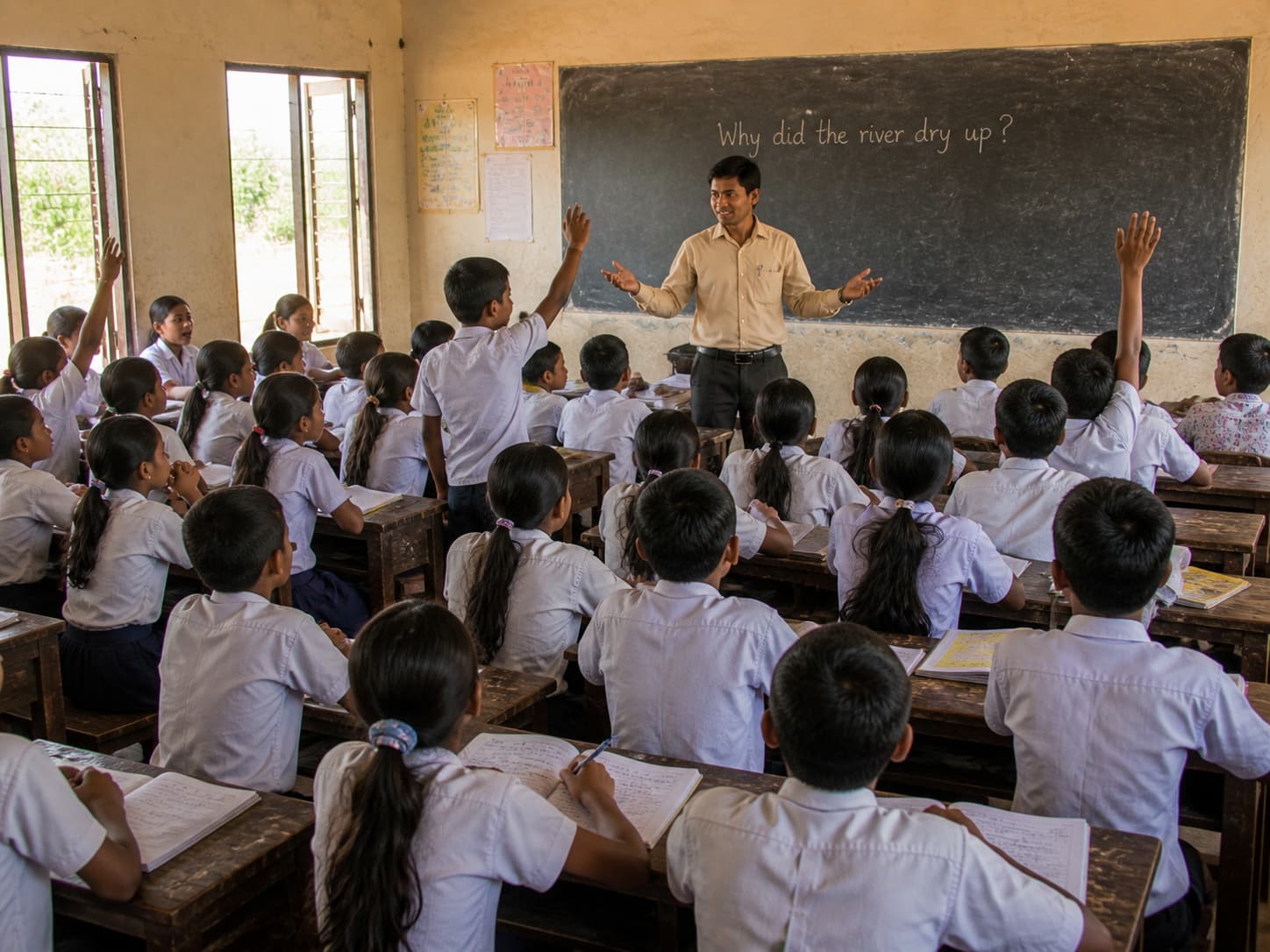
The scenario: Mrs Okafor is teaching a lesson on rivers. She has just asked: “Why did the river dry up?” A good question.
Three hands shoot up immediately — the same three as always. Two seconds pass. She picks one. He gives a one-word answer: “Drought.” She says “Good!” and moves on.
In the back row, a girl named Fatima had a longer answer forming in her head. She was thinking about the trees being cut down, and the rain coming less often, and how her own grandmother told her stories about a different river. But she needed twenty seconds to put it into words. She got two.
Across the lesson, Mrs Okafor asks twenty-three questions. Twenty-one of them have a one-word answer. Five students do almost all the answering. The rest of the class is quiet.
The lesson ends. Mrs Okafor feels it went well. The students were “answering questions.” But really — were they thinking?
Think about: the type of questions, who answers, how long Mrs Okafor waits, and what happens after an answer.
The lesson looks fine on the surface, but several things are going wrong:
- Almost all closed questions. 21 out of 23 had a one-word answer. There is little room for real thinking.
- Two seconds is not enough. Most students need 5 to 15 seconds to think of a good answer. Fatima needed 20 — and could have given a wonderful answer if she had got them.
- The same five students. Mrs Okafor is getting feedback from a small minority. She does not actually know what the rest of the class understands.
- No follow-up. “Drought” was a fine answer. But “Why? What caused the drought? What else might have happened?” would have unlocked twenty more minutes of real learning.
- The hidden cost. Fatima — and dozens like her — learn quickly that their kind of thinking is not wanted in this classroom. Over months, they stop trying.
There is no single right answer — pick the change you think would have the biggest impact on her students’ learning.
Think about each strategy and write what you would actually do in your own classroom.
| Teaching Strategy | Your ideas |
|---|---|
| Mix open and closed questions | |
| Wait longer for answers | |
| Choose who answers, by name | |
| Ask weaker students first | |
| Ask follow-up questions | |
| Use real check questions, not “Do you understand?” |
Each of these is a small change. None costs anything. Together they transform a classroom.
| Teaching Strategy | Action |
|---|---|
| Mix open and closed questions | Plan two or three open questions before each lesson. Closed for facts; open for thinking. Most lessons need both |
| Wait longer for answers | Count to 10 silently after you ask. It feels uncomfortable. Do it anyway. Quiet students need this time |
| Choose who answers, by name | Tell the class: “I will choose — do not shout out.” Then pick names from across the whole room, not just the front |
| Ask weaker students first | For easier questions, call on weaker students first. They build confidence. Stronger students can add more later |
| Ask follow-up questions | After any answer, ask: “Why?” or “Can you say more?” or “Does anyone agree or disagree?” Go deeper |
| Use real check questions | Do not ask “Do you understand?” — everyone says yes. Instead, ask a question that only an understanding student could answer. “So — in the example I gave, who is the subject?” |
Two extra tips:
- Use pair talk first for hard questions. “Talk to your neighbour for one minute. Then I will choose someone to share.” Quiet students get to think out loud first — safely.
- Only nominate students if you think they can answer. Asking a weaker student a question that is too hard, in front of the class, can damage their confidence for weeks.
Q6. Watch the video below of three teachers talking about what changed when they thought more carefully about their questions.
Host: Three teachers share what changed when they thought more carefully about the questions they asked.
Teacher 1: I used to ask only yes-or-no questions. “Did Mary go to the market? Yes. Is this a verb? Yes.” The students were not really thinking. They were just guessing.
Teacher 2: When I asked a question, I waited maybe two seconds. The same three students always shouted the answer. Everyone else just watched.
Teacher 3: I would ask a question, and when a student answered, I just said “good” and moved on. I never asked why or how. I never went deeper.
Teacher 1: Now I mix my questions. Yes-or-no for quick checks, but also why and how questions for real thinking. “Why did Mary go to the market? What might she buy?” The class talks much more.
Teacher 2: I count to ten in my head before I take an answer. And I do not let students shout out — I choose who answers, by name. Now even the quiet students take part.
Teacher 3: I keep going. After a student answers, I ask “Why do you think that?” Or “What would happen if it was different?” One question can become five. The thinking gets deeper.
Host: Three changes. Mix your question types. Wait, then nominate. And keep digging deeper. The questions are simple — but the learning is much richer.
Q7. For each strategy, choose the option that best describes where you are now.
Be specific. For example: “Tomorrow I will plan two open questions for my history lesson, and count to 10 silently after I ask them.”
- Questions are your most powerful teaching tool — the better the question, the deeper the learning
- Mix closed (one right answer) and open (many possible answers) questions in every lesson
- Wait at least 10 seconds after asking — silence is the sound of thinking
- Choose who answers by name — spread questions across the whole class, not just the loud few
- Never trust “Do you understand?” — ask a real check question that shows whether they actually do
How useful did you find this lesson? Leave a rating and a comment to help other teachers.