Choose your language
Supporting shy students
Host: Think about your last lesson. Who answered your questions? Probably the same three or four students. Hands up. Voices loud. Confident.
But what about the others? The student in the corner who never speaks. The one who looks down when you ask a question. The one who whispers the answer to a friend, but never to you.
Are these students learning less? Or are they just learning quietly? And how do we know the difference?
Shy is not the same as not learning. But quiet students need our help just as much — sometimes more — than the loud ones.
Q2: Which of these things do you notice about your shy students? (Tick all that match.)
What you have noticed is real and important. Shy students often:
- Hide. The back row and corners are where shy students go to feel safe. They become almost invisible.
- Avoid risk. Putting your hand up is a risk. So is looking the teacher in the eye. Shy students protect themselves by doing neither.
- Whisper. Many shy students do know the answer. They just cannot say it in front of 50 other people.
- Write more than they speak. A pen and paper feels safer than a voice. Use this.
Being shy is not the same as not knowing. It is also not a problem to fix — some students will always be quieter than others, and that is fine. The goal is not to change their personality. The goal is to give them safe ways to take part and to show what they have learned.
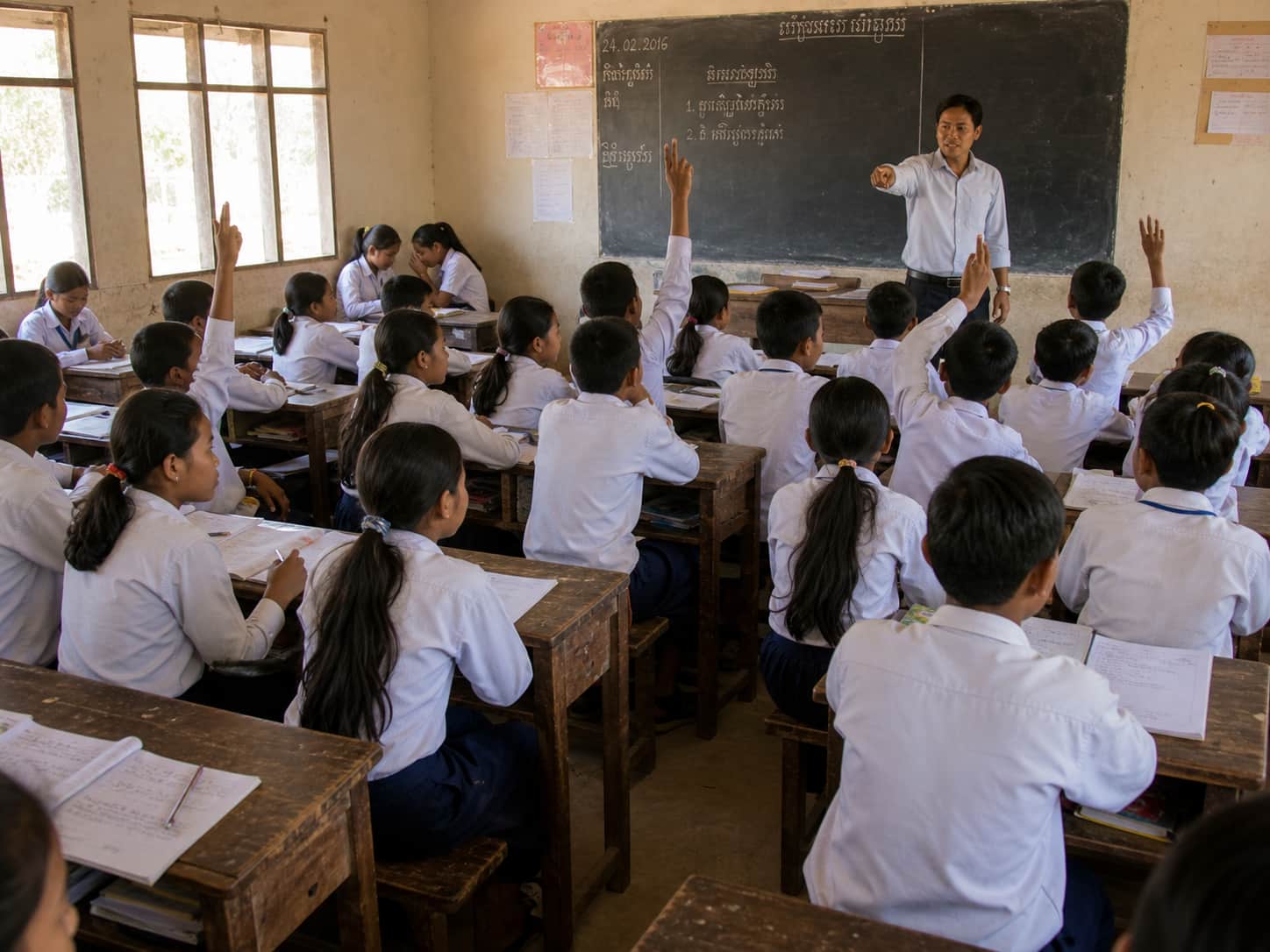
The scenario: Mr Bekele teaches a class of 47 students. He has just asked a question about the lesson. Four hands shoot up — the same four every time. He picks one of them. Good answer. He moves on.
At the back of the room, Aida knows the answer too. She has written it carefully in her book. But she will not put her hand up. She never does. Mr Bekele has not spoken to her in three weeks.
Next to Aida, Sami whispers an answer to his neighbour. His neighbour says it out loud. The neighbour gets the praise. Sami says nothing.
By the end of the lesson, Mr Bekele feels the lesson went well. The class answered his questions. But really, only four students did. The other forty-three sat quietly — some learning, some not, and Mr Bekele does not know which is which.
Think about Aida, Sami, and the other forty-three quiet students. What is Mr Bekele not seeing?
The scenario shows several common problems — problems many of us have, often without noticing:
- The same students answer every time. When you only call on the loud ones, you get a false picture of how the class is doing. You only know what four students know.
- Aida knows the answer but cannot share it. Her learning is invisible. Mr Bekele cannot help her improve because he does not know what she can do.
- Sami’s ideas get taken by someone else. Over time, this teaches him that his thinking is not valued. He will whisper less and less.
- No real check on most of the class. Forty-three students sat quietly. Were they learning? Confused? Bored? Mr Bekele has no idea.
- The shy students are not the problem. The way the lesson is set up is the problem. A few small changes can make space for everyone.
Choose the change you think would help shy students the most. Be specific.
Think about each strategy and write what you would actually do in your own classroom.
| Teaching Strategy | Your ideas |
|---|---|
| Start with pair or small group talk | |
| Give thinking time before answers | |
| Change the seating regularly | |
| Use writing as well as speaking | |
| Praise effort, not just right answers | |
| Talk to shy students one-to-one |
None of these strategies is hard. None costs money. All of them work.
| Teaching Strategy | Action |
|---|---|
| Start with pair or small group talk | Before asking the class, ask students to share with one partner. Talking to one person is much safer than talking to fifty |
| Give thinking time before answers | After a question, count to ten in your head. Silence is the sound of thinking. Shy students need this time |
| Change the seating regularly | Move students every two weeks. No one should sit at the back forever. Walk around the room while teaching |
| Use writing as well as speaking | Ask students to write an answer first. You can read what shy students know, even if they cannot say it out loud |
| Praise effort, not just right answers | Notice when a shy student tries — even a small attempt. Praise the trying, not just the correctness |
| Talk to shy students one-to-one | A 30-second chat at the start or end of class can change everything. They feel seen. You learn what they know |
One important reminder: some shy students do not want to be brought to the front of the class or asked direct questions in public. Others actually do want this, to feel they belong. Watch each student. Ask yourself what each one needs — not what shy students need in general.
Q6. Watch the video below of three teachers talking about how they helped their shy students.
Host: Three teachers share how they helped their shy students join in.
Teacher 1: I had a girl in my class. For three months, she did not speak once. I would ask her questions and she would just look at her desk.
Teacher 2: My shy students always sat at the back. They were invisible. I called on the same five loud students every lesson without even noticing.
Teacher 3: I used to wait two seconds for an answer. If no one spoke, I just answered the question myself. The shy students never had a chance.
Teacher 1: I started with pairs. Just two students talking together. She could whisper an answer to one friend. After a few weeks, she shared ideas in a group of four. Now, six months later, she sometimes speaks to the whole class.
Teacher 2: I changed the seats every two weeks. Now no one sits at the back forever. I also walk around the room while teaching. The shy students cannot disappear when I am standing right next to them.
Teacher 3: I count to ten in my head before I take an answer. Ten seconds. It feels long, but it gives shy students time to think. Now I get answers from students who never spoke before.
Host: Three small changes. Pair work first. Move the seats. And give thinking time. The shy students were always there — they just needed a way in.
Q7. For each strategy, choose the option that best describes where you are now.
Be specific. For example: “On Monday, I will give Aisha thinking time, then ask her to share her answer with one partner first.”
- Shy is not the same as not learning — many quiet students know far more than they show
- The goal is not to change shy students’ personalities — it is to give them safe ways to take part
- Pair talk and small groups are the safest first step — talking to one person is much easier than talking to fifty
- Thinking time, changing seats, and walking around the room are simple changes that include everyone
- Watch each shy student as an individual — some want to be invited forward, others need to stay quiet for now
How useful did you find this lesson? Leave a rating and a comment to help other teachers.