Choose your language
Managing textbook bias
Textbooks are one of the most important resources in a classroom. But have you ever stopped to think about whose stories, images, and ideas are included in your textbook — and whose are left out?
Textbook bias happens when a book presents information in a way that favours certain groups of people over others. This can happen in many ways. Some textbooks show mostly men in professional roles, while women appear mainly in home settings. Some books focus only on the history and culture of certain countries or ethnic groups. Others use language that treats one group as the “normal” and another as the “exception”.
Bias in textbooks is often not deliberate — it reflects the assumptions of the people who wrote and designed them. But even unintentional bias can affect students. When students do not see themselves represented in their learning materials, they may feel that their lives and experiences are less important or less valid.
Think about your own textbooks. Who is shown in the pictures? Whose names appear in the examples? Which countries, cultures, and traditions are mentioned? And which ones are missing? In this session, we will look at how to recognise bias in textbooks and what you can do to manage it in your classroom.
Q2: Which types of bias have you noticed in textbooks you have used? (Tick all that apply)
- These forms of bias are very common — most teachers notice at least one of them in their materials
- Bias is often invisible until we start looking for it actively
- Recognising bias is the first step — the next step is deciding how to respond to it in class
- You do not need a new textbook to manage bias — small changes to how you teach can make a big difference
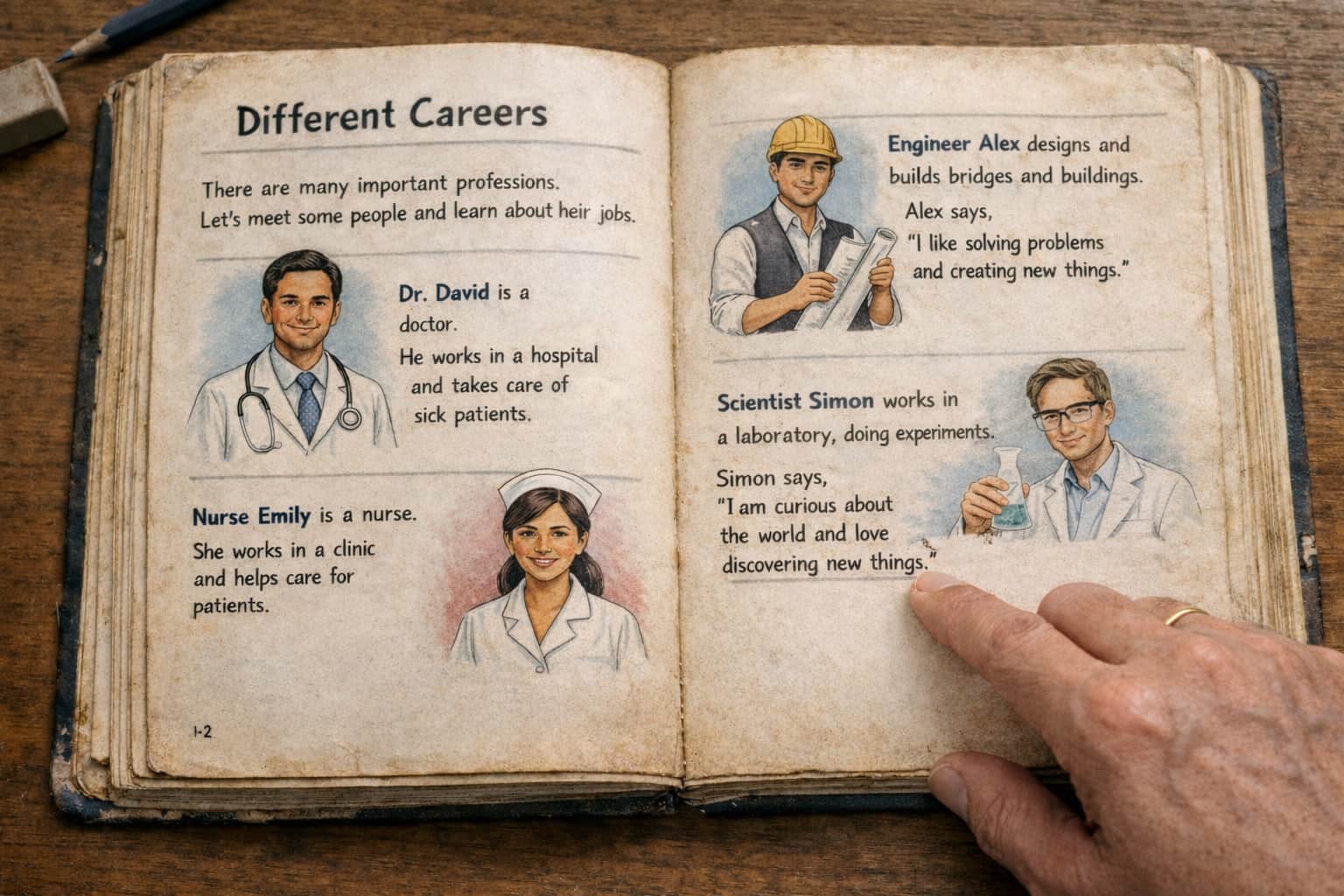
Think about female students, students from different cultural backgrounds, and students who are considering different careers. What might they feel when they read this passage?
- Female students may feel that high-status careers such as doctor or engineer are not intended for them
- Students from different cultural backgrounds may feel that their lives and communities are not valued or visible
- Students who do not see names like their own in the text may feel excluded from the world being described
- These messages are often absorbed silently — students may not say anything, but the effect on confidence and aspiration can be significant
- Even one biased passage, used without comment, can reinforce harmful stereotypes
Think about what the teacher could say before, during, or after reading. Could the bias itself become a teaching point?
- Yes — a biased passage can be used as a critical thinking exercise, asking students to identify what is missing or who is not represented
- The teacher can challenge the text by asking questions like: “Why do you think the doctor is always called ‘he’?” or “Who else could be in this picture?”
- Supplementing the passage with local examples, different names, or additional context can counterbalance the bias
- Making the bias visible and discussing it openly teaches critical thinking and media literacy — valuable skills beyond the language classroom
Write your ideas for each strategy in the table below.
| Strategy | Your ideas |
|---|---|
| Before reading | |
| During reading | |
| After reading | |
| Rewriting or adapting | |
| Adding local context |
You do not need to replace your textbook. Small, deliberate changes in how you use it can greatly reduce the impact of bias on your students.
| Strategy | Ideas to try |
|---|---|
| Before reading | Ask students to predict who they think will appear in the passage — then compare their predictions with what is actually there |
| During reading | Pause and ask: “Who is not in this text?” or “How would this be different if it was written in our country?” |
| After reading | Ask students to rewrite one sentence or paragraph to include someone more like themselves |
| Rewriting or adapting | Change pronouns, names, or roles before printing or reading aloud — a simple and quick adjustment |
| Adding local context | Add two or three local examples, names, or jobs to connect the content to students’ own lives and communities |
Q6. Watch the video below of teachers talking about how they manage bias in their textbooks.
“When I first looked carefully at my textbook, I was surprised. Almost all of the people shown in professional jobs were men. I started pointing this out to my students — not to criticise the book, but to start a conversation.”
“I used to use the textbook exactly as it was. Then a student asked me, ‘Why are there no people from our country in this book?’ That question changed how I teach. Now I always add local examples alongside the textbook.”
“I started rewriting small parts of passages before class — changing names, or changing ‘he’ to ‘she’ or ‘they’. It takes five minutes and my students notice. It shows them that these roles are open to everyone.”
“I now use biased passages as a critical thinking activity. I ask students, ‘What is missing here?’ and ‘Who is not being talked about?’ My students have become very good at spotting bias — in textbooks, but also in the media and in everyday life.”
“I do not always have time to redesign lessons. But I try to say at least one thing each time I use a biased passage — something like, ‘In real life, engineers can be women too.’ Small comments matter.”
You do not need a perfect textbook to teach inclusively. What matters most is what you say and do around the textbook you already have.
Q7. For each strategy, choose the option that best describes where you are now.
- Textbook bias is common and often unintentional — but it still affects how students see themselves and their possibilities
- Bias can appear in images, names, language, examples, and whose stories are told
- You do not need a new textbook — small changes in how you use existing materials can make a big difference
- Making bias visible and discussing it openly builds students’ critical thinking skills
- Adding local names, examples, and context helps all students feel represented and valued in their learning
How useful did you find this lesson? Leave a rating and a comment to help other teachers.