Choose your language
Managing playtime effectively
Playtime is an important part of school life, especially for younger students. It supports physical, social, and emotional development. However, playtime can also become unsafe or difficult to manage if it is not well organised. In some schools, students of different ages play together, which can sometimes cause problems. Limited space and resources can also make playtime challenging. Think about your own school — is playtime safe for all students? Do younger and older students play together? How do you manage behaviour during playtime?
Q2: Which of these challenges do you see during playtime?
- These challenges are common — they often happen when playtime is not structured or monitored
- Teachers can improve safety by organising space, time, and resources more carefully
- Talk with colleagues to identify problem areas and agree on how playtime should be managed
- Even simple changes to supervision and routines can make a big difference
Think about who controls popular items like balls or toys. Are there students who get left out?
- Some students may control popular items like balls or toys, leaving others out
- Teachers can create simple systems — like sharing rotas — to ensure fairness
- Equal access to play supports inclusion and reduces conflict between students
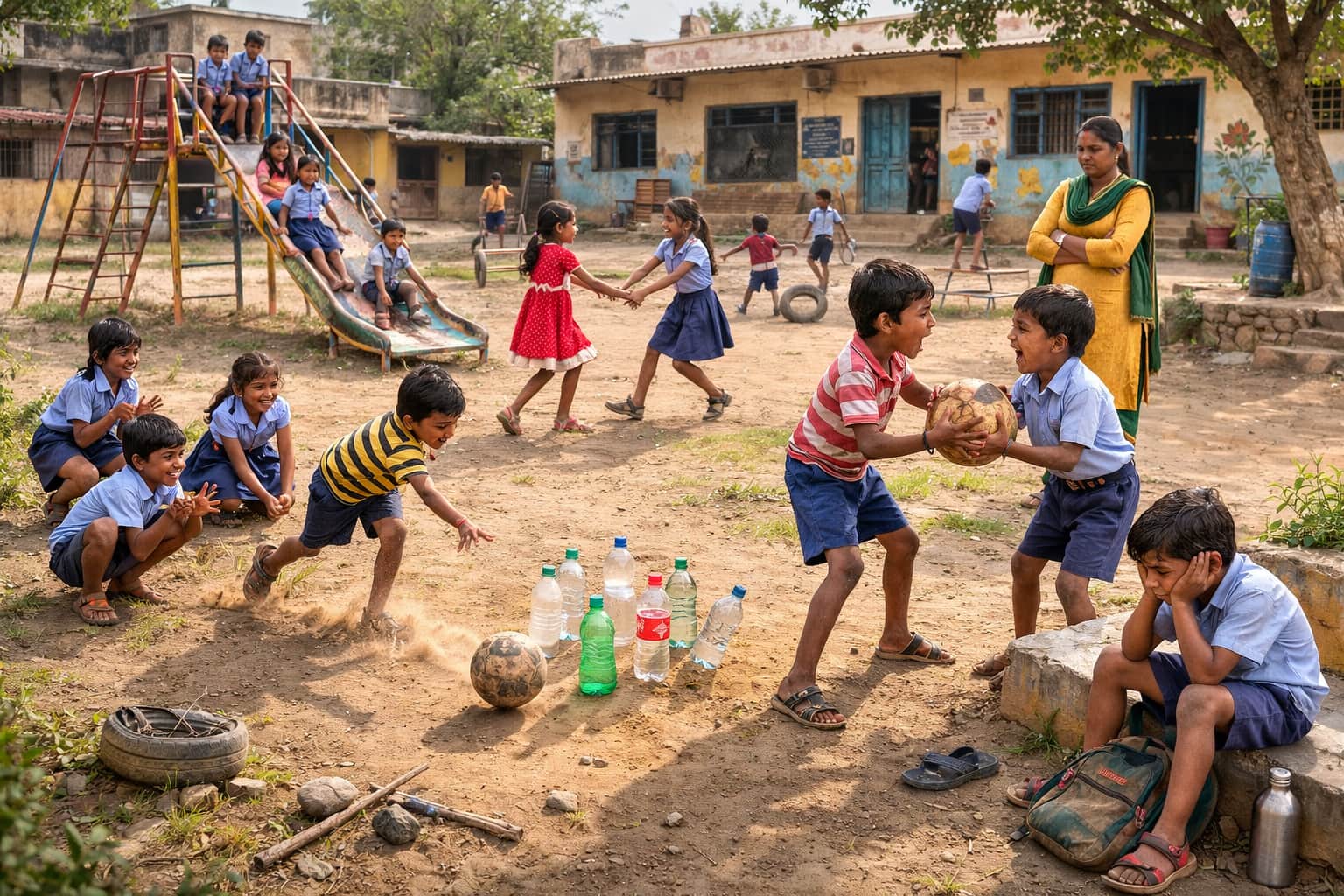
Think about: what the teacher is doing, how students are behaving, the equipment being used, and whether all students are included.
- The teacher being present is positive — but active monitoring and intervening when problems arise is even more effective
- The argument over the ball and the isolated child are warning signs that need attention
- Equipment should be checked regularly for safety — especially metal structures
- Creative use of local resources like plastic bottles is fine — but glass bottles are not appropriate
- Not all students feel included — a peer support system or structured activities can help
Write your ideas for each strategy in the table below.
| Teaching Strategy | Your ideas |
|---|---|
| Separating age groups | |
| Checking playground safety | |
| Monitoring during playtime | |
| Sharing equipment fairly | |
| Peer support system |
These are practical, low-cost changes that can make playtime safer and more enjoyable for all students.
| Teaching Strategy | Action |
|---|---|
| Separating age groups | Have younger and older students play at different times so younger students feel safe |
| Checking playground safety | Regularly inspect the space for broken objects, unsafe equipment, or dirty areas |
| Monitoring during playtime | Stay present and actively supervise — your presence reduces problems before they start |
| Sharing equipment fairly | Create a simple rota so all students get equal access to popular items like balls |
| Peer support system | Ask older students to help and include younger ones — a “playground friends” system |
Q6. Watch the video below of teachers talking about the changes they made to playtime.
Playtime can be a positive experience when it is managed carefully.
“In my school, younger students felt unsafe playing alongside older ones. We started having playtime at different times for different ages — it made a huge difference.”
“I checked the playground and found unsafe areas where there was broken glass. We cleaned and improved the space. Now students have somewhere safe to play.”
“We don’t have many resources, but students use tyres, sticks and stones creatively. They enjoy it. I also created a rota so all students can use popular items like balls.”
“I stay outside during playtime now. My presence helps students feel safe and reduces problems before they start.”
“We started a ‘playground friends’ system. Older students help younger ones during playtime. Simple, low-cost — and it really works.”
Simple, low-cost changes can make playtime safer, fairer, and more enjoyable for all students.
Q7. For each strategy, choose the option that best describes where you are now.
- Playtime supports physical, social, and emotional development — it is an important part of school life
- Poorly managed playtime can lead to safety problems, conflict, and students feeling excluded
- Separating age groups can help younger students feel safe and reduce conflict
- Simple, locally available resources are enough for meaningful and enjoyable play
- Active monitoring and fair sharing of equipment improve behaviour and inclusion for all students
How useful did you find this lesson? Leave a rating and a comment to help other teachers.