Choose your language
Bringing the community into the classroom
The classroom door is closed. Outside that door is your community: farmers, shopkeepers, drivers, tailors, mothers, grandmothers, builders, market traders, religious leaders, nurses. People with stories, jobs, opinions, knowledge, language. People who could change your students’ English lessons in ways that no textbook can.
Most of these people will never come into your classroom. They will not be invited. The school will stay closed. The textbook will stay open. Lessons will continue to be about places students will never see, written by people students will never meet.
This is one of the biggest missed opportunities in language teaching, especially in challenging settings. Your community is a free, infinite, deeply personal resource. And bringing one piece of it into your classroom — even once a term — can transform what English means for your students.
In this lesson, we will look at five practical ways to do this — from the smallest, easiest start to the most ambitious. None require money. All work better when you start small.
Q2: Which of these get in the way of using your local community in lessons? (Tick all that apply)
- The most common myth: community members cannot help with English because they do not speak English. They can. Your students translate. The community member shares in L1. Both languages are working — and your students get real translation practice
- If your school does not encourage visitors, you may need to start very small — outside-of-class activities, oral history projects students do at home, a parent walking past who is invited for five minutes
- If you worry about safety: always supervise visitors closely. Never leave them alone with students. The PDF is clear on this and it matters — visitors should never be unsupervised in classrooms
- If textbook coverage feels rigid, remember: the community can teach the same language as the textbook. A visitor talking about their job teaches present simple, occupations vocabulary, question forms — same content, much more memorable
- You do not need to do everything in this lesson. Pick one technique, try it once a term. That alone will be more community engagement than most schools manage
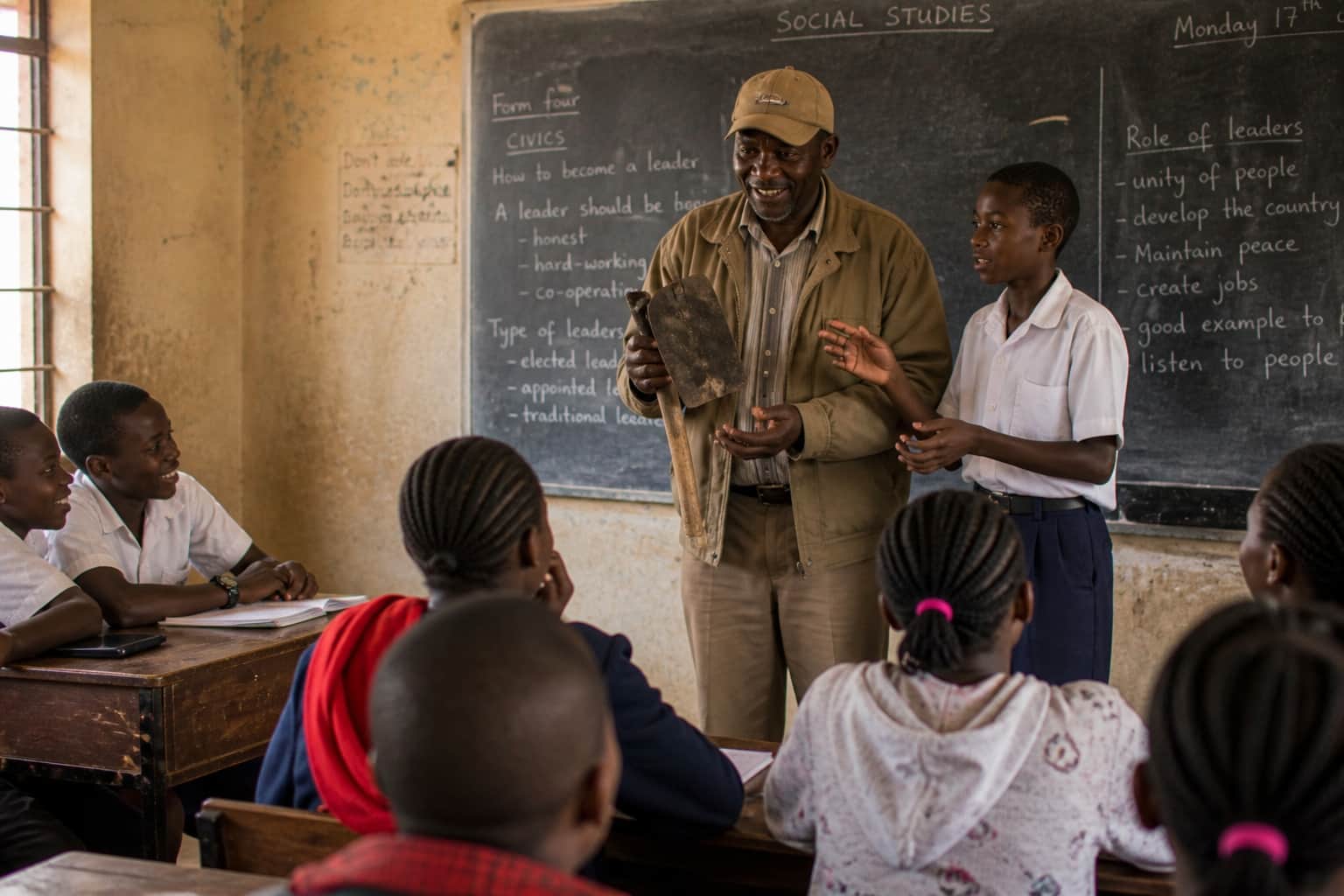
Your community is the richest English-teaching resource you have. And it is free.
A textbook story about a holiday is fiction. A neighbour who has actually travelled is real. A textbook description of a job is generic. A grandmother explaining what farming was like 40 years ago is unforgettable. The community brings something no textbook ever can: truth, surprise, and personal connection.
The five techniques below are ordered by effort — from things you can do tomorrow to things that build over months. None require money. All work in any context. Pick one to start with.
Be honest about constraints — school rules, class size, your time, community willingness. The right technique is the one you can actually do.
- For most teachers, the easiest start is Technique 1 (using the local environment as content). It needs no permission, no setup, no visitors. You can do it tomorrow
- Technique 2 (interview homework) is also low-risk. Students do the work outside school. The classroom just collects and uses the answers
- Technique 3 (Guess my job) is the easiest way to actually bring someone into the classroom. 15 minutes, low-stakes, often very memorable
- Technique 4 (oral histories) needs more time and planning, but produces some of the richest content for student writing and reading
- Technique 5 (community classes) is the most ambitious. It needs school leadership support and a confident teacher. Save it for later if you are starting from no community engagement at all
These are real situations from teachers’ experience. The right answer is the one most likely to actually make community engagement happen.
Be specific about who, when, what. The more concrete, the easier to actually do.
| Technique | Your specific idea |
|---|---|
| Use the local environment as content | |
| Send students out with interview tasks | |
| Invite a community member (“Guess my job”) | |
| Capture older people’s stories | |
| Run language classes for the community |
| Technique | How it can work |
|---|---|
| Use the local environment as content | For a unit on prepositions: students draw a map of their area and label it in English (“the river is next to the road”, “the church is between the shops”). For a unit on present simple: students describe a market day or a typical morning in the village. |
| Send students out with interview tasks | Three simple questions to one adult at home: “What was your first job?” “How has our area changed?” “What is one thing you wish you had learned at school?” Students bring back the answers next lesson. Use them for past tense practice, comparisons, or class discussion. |
| Invite a community member (“Guess my job”) | Invite a tailor, farmer, mechanic, market trader, nurse. They mime their job. Students ask yes/no questions in English. After they guess, follow-up questions about how the person learned their trade. Always supervise visitors closely. |
| Capture older people’s stories | Pick a theme: festivals, technology, school, family. Students interview an older person at home in any language. Bring stories back to class. Students summarise in English — a short paragraph, a poster with English labels, or a play with mixed L1/L2. |
| Run language classes for the community | If realistic: older students could run a short weekly class for younger children or out-of-school youth. Functional topics: introductions, families, food, jobs. Even half an hour a week creates real impact and powerful learning for your students. |
Q6. Watch the video below. Think about which change is easiest for you to try first.
Host: We have just looked at five ways to bring the community into your English classroom. Now listen to three teachers. They share their problems first, then the changes they made.
Teacher 1: For years I taught my students about cities they would never see. Restaurants they would never eat in. Trains they would never ride. The textbook was full of these things. My students could not connect with any of them. They learned the words but the words felt foreign — not just in language, but in life.
Teacher 2: I wanted to invite community members in but I was afraid. What if they did not know what to say? What if my head teacher did not approve? What if the children did not respect them? I kept putting it off. Year after year, I never invited anyone.
Teacher 3: I assumed older people had nothing to offer an English class because they did not speak English. I was wrong. I just had not thought about how language teaching could include them.
Teacher 1: I started small. Instead of teaching present simple with a textbook story about a businessman in London, I asked my students: “Describe a typical morning in your house.” They wrote and they spoke. Suddenly the present simple was about cooking, fetching water, walking to school. The grammar lesson became theirs.
Teacher 2: I finally invited one person. The school cleaner, who had worked there for thirty years. She was nervous, but I asked her simple questions: “How long have you worked here? What was the school like before? What do you love about it?” A student translated. The class was completely silent. They had never heard her story. Afterwards they wrote about her in English. That was a year ago. Since then, I have invited eight different people.
Teacher 3: I sent my students to interview their grandparents about life when they were young. They came back with stories I had never imagined — about journeys, about old festivals, about a way of life that was disappearing. We made posters. The grandparents came to see them. Some of them cried. The English in those posters was not perfect — but it was theirs, and it was real.
Host: None of these teachers had different communities. They had the same farmers, mothers, traders, elders that surround every school. They just opened the door — one small step at a time. The lessons that came through that door were unforgettable.
Q7. For each technique, choose the option that best describes where you are now.
One activity. One step. Even Technique 1 (using the local environment) counts. The shift starts with one lesson where the community comes through the door.
- Your community is the richest English-teaching resource you have — and the most overlooked. Farmers, traders, elders, drivers all bring real language, real stories, real connection
- The biggest myth is that community members cannot help with English because they do not speak English. They can. Students translate — which is real practice for them too
- Five techniques, ordered by effort: use the local environment as content, send students out with interview tasks, invite community members in (Guess my job), capture oral histories, run community classes
- Start small. Technique 1 (local environment) needs no permission and no visitors. The most ambitious techniques can wait until small wins build confidence and trust
- Always supervise visitors closely. Plan their visit with them in advance. Set clear timing. Brainstorm questions with students beforehand. The visit goes much better when everyone is prepared
How useful did you find this lesson? Leave a rating and a comment to help other teachers.