Choose your language
Managing very large classes
Fifty students. Sixty students. Sometimes more. The desks are fixed. The room is loud. You cannot reach every student in a 40-minute lesson. You cannot mark every book the same week.
Many teachers feel they are failing their students simply because the class is too big. But this is the wrong way to look at it. A large class is not a smaller class with more students. It is a different kind of classroom — with different challenges, but also different strengths.
You cannot give 60 students one-to-one attention. You can build a classroom where students learn from each other, where you teach the whole room without losing anyone, and where every minute counts.
In this lesson, we will look at simple, practical ways to manage a very large class — without burning out.
Q2: Which of these are problems for you when teaching very large classes? (Tick all that apply)
- All of these are real problems and you are not alone — teachers everywhere with large classes face them daily
- The biggest mistake is trying to teach a 60-student class the same way you would teach a 25-student class. The methods are different
- You cannot give every student your direct attention — but you can build a classroom where students help each other learn, and where every student has a chance to be active
- Most large-class problems are solved by structure, not effort. The right routines and groupings save you energy, not cost it
- Even small changes (numbering students, using the back of the room, sampling instead of marking everything) make a big difference
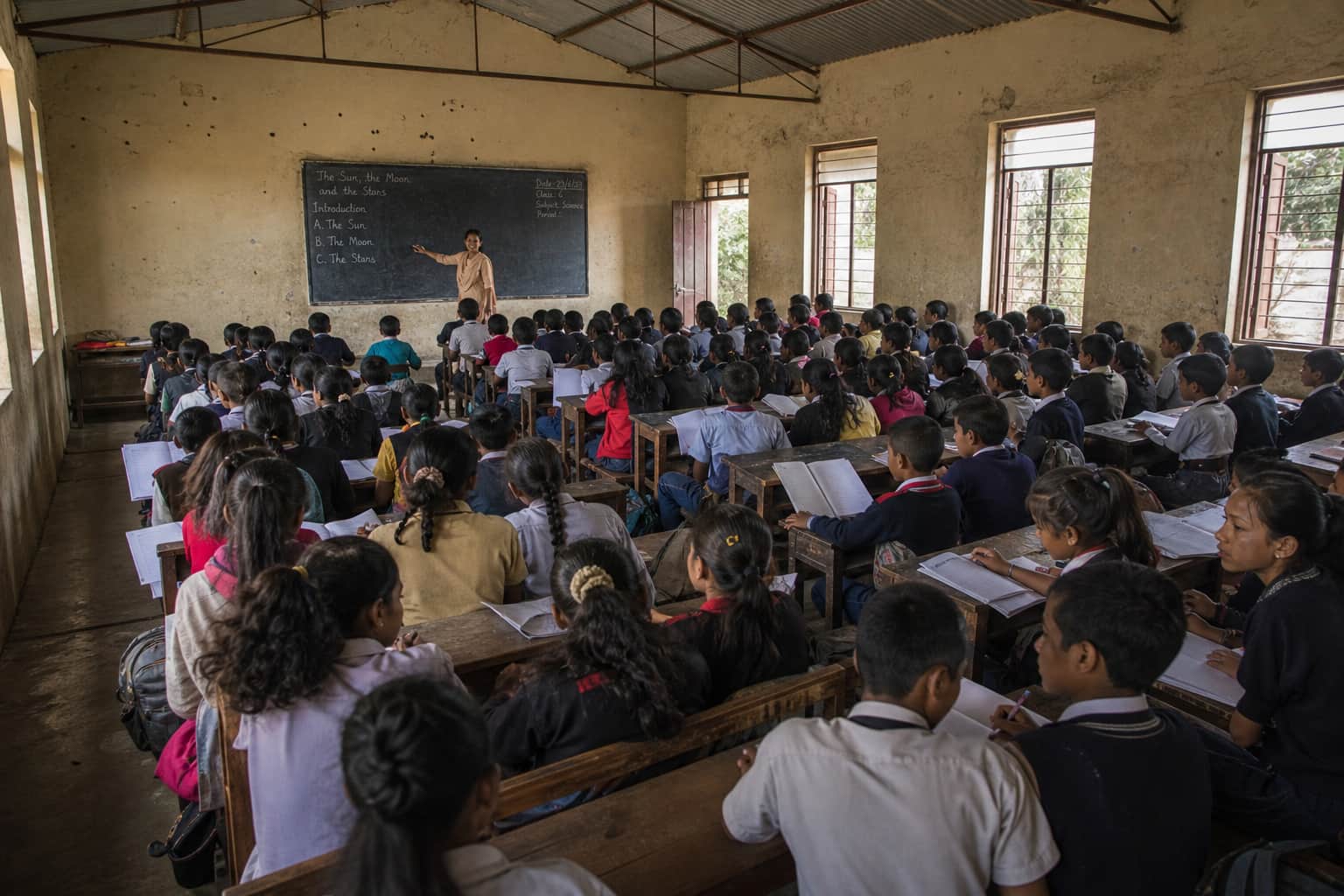
Most teacher training is built for classes of 20–30 students. But many teachers face 50, 60, or even 80 students.
The natural reaction is to try harder. Speak louder. Walk faster. Mark more books at home. This leads to exhaustion, and to the same students still not getting attention.
The shift is to stop thinking about reaching every student personally, and start building systems that let students reach each other. A large class has more knowledge, more variety, more energy. The job of the teacher is to channel that energy — not to replace it.
Five practical techniques that work in classes of 50+:
Be specific about your largest class. The technique that fits best depends on your room, your students, and your subject.
- If you teach younger or shyer students: numbering and whole-class signals are usually the easiest start
- If your class has lots of off-task chatter: walking to the back of the room (Technique 2) often calms things by itself
- If you are buried in marking: sampling (Technique 3) frees you up the fastest. It works best paired with peer or self-checking from the assessment lessons on this site
- Peer leaders (Technique 4) take a few weeks to set up well, but once it works, it transforms a class. Worth the effort
- Pick one technique. Try it for two weeks. Add another. Three new habits in three months changes how you teach
Use what you have learned so far. There is no single answer — the goal is to think about the problem from a structural angle.
The problem is not the 8 students — it is the system. Some structural fixes:
- Use whole-class signals (Technique 5) instead of asking for hands. Now all 60 students answer at once
- Stop accepting answers from the first hand up. Wait 5 seconds. Then call on someone who did not raise their hand
- Have students discuss the answer with their neighbour first (30 seconds). Now even shy students have something to say
- Number the students. Use the numbers to call on people: “Number 4 in the back row, what do you think?”
- Walk to the back of the room. Ask a question while you are there. The dynamic shifts immediately
The shift: stop expecting students to volunteer. Build a system where everyone is included by default.
Think about your subject, your largest class, and what would actually fit your room and students.
| Strategy | Your specific ideas |
|---|---|
| Number students for fast grouping | |
| Teach from different parts of the room | |
| Sample some books, do not check all | |
| Use peer leaders to support groups | |
| Use whole-class signals (hands, fingers, stand up) |
| Strategy | How it can work |
|---|---|
| Number students for fast grouping | Once a month, go around and renumber students 1–6. Keep the same numbers all month. When you say “groups of 4, one of each number” or “all the 3s come here”, students move in 30 seconds. |
| Teach from different parts of the room | Plan one moment per lesson where you teach from the back, the side, or the middle. Start small — even one minute changes the energy of the class. |
| Sample some books, do not check all | Take 6 books to mark in detail. Note the 2–3 most common errors. Address these at the front in the next lesson. The other 54 books get peer-checked or self-checked using the answers. |
| Use peer leaders to support groups | At the start of group work, tap 6 students on the shoulder and quietly say: “You are the group leader for this task. Help your group. Only call me for questions you cannot answer.” Rotate next time. |
| Use whole-class signals (hands, fingers, stand up) | Replace “Who knows the answer?” with “Show me with your fingers: 1 for option A, 2 for option B, 3 for option C.” You see the whole room in 5 seconds. |
Q6. Watch the video below. Think about which change is easiest for you to try first.
Host: We have just looked at five techniques for managing very large classes. Now listen to three teachers. They share their problems first, then the changes they made.
Teacher 1: My class has 64 students. For my first three years, I felt I was failing every day. I could not get to everyone. I would go home with my voice gone, my back hurting, and a bag full of books I could not finish marking. I thought I was not good enough.
Teacher 2: I had the same eight or nine students answering every question. The rest of the class was quiet, sometimes asleep. Group work was a disaster — some groups did everything, others did nothing. I felt like I was teaching half a class and ignoring the rest.
Teacher 3: I taught from the front of the room every lesson. The students at the back were a different world — chatting, looking out the window. I shouted at them, but it never lasted. I did not know what else to do.
Teacher 1: I started sampling. Six books a lesson, in detail. I shared the common errors with the whole class. The marking pile got smaller. The students started learning faster — because I was actually addressing what they got wrong, not just ticking pages.
Teacher 2: I numbered all my students 1 to 6, once at the start of the term. Now in 30 seconds I can split the class into groups, or pair them with someone different. I also stopped taking the first answer. I wait 5 seconds. I call on a number, not a hand. Different students answer now.
Teacher 3: I made one rule for myself: every lesson, I teach from the back at least once. Just for one minute. The change was bigger than I expected. The back of the class is now part of the lesson. Some of those students have started raising their hands.
Host: None of these teachers had smaller classes. None had more resources. They changed the system, not the size. Three small structural changes can transform a class of 60.
Q7. For each strategy, choose the option that best describes where you are now.
Just one. Be specific about which class, which lesson, and exactly what you will do.
- A very large class is not a smaller class with more students — it needs different methods. Trying harder with the old methods leads to burnout, not better teaching
- You cannot give every student personal attention. Build a system where students help each other and where every student is active
- Numbering students, using the whole room, sampling work, peer leaders, and whole-class signals are five techniques that work in classes of 50+
- Most large-class problems are solved by structure, not effort. The right routines save energy, not cost it
- Pick one technique. Try it for two weeks. Add another. Three new habits over a term changes how the whole class feels
How useful did you find this lesson? Leave a rating and a comment to help other teachers.